Introduction
You can learn all the regular Spanish endings in one afternoon, and then tengo, voy, puedo, and soy show up and break every rule. The good news: irregular present tense verbs Spanish are not random. They follow patterns, and once you learn the patterns, dozens of verbs become easy.
This guide gives you the patterns, a full conjugation chart for the most important verbs, common mistakes to avoid, and 15 practice questions with answers. No sign-up and no downloads.
What Are Irregular Present Tense Verbs Spanish?
A regular Spanish verb follows standard endings: hablo, hablas, habla, hablamos, habláis, hablan for -ar verbs, with matching patterns for -er (como) and -ir (vivo) verbs.
Irregular Present Tense Verbs Spanish breaks this pattern in at least one form. The irregularity might be a changed stem, a special yo form, or a completely different set of forms. Many of the most common Spanish verbs are irregular, so you will meet them on day one.
5 Types of Irregular Verbs
1. Irregular “Yo” Form Verbs
These irregular present tense verbs Spanish are regular in every form except yo. This is the easiest group to learn.
| Pattern | Verbs (infinitive → yo form) |
|---|---|
| -go verbs | hacer → hago, poner → pongo, salir → salgo, traer → traigo, caer → caigo, valer → valgo |
| -zco verbs | conocer → conozco, parecer → parezco, ofrecer → ofrezco, traducir → traduzco, producir → produzco |
| Other special yo forms | saber → sé, dar → doy, ver → veo, estar → estoy, caber → quepo |
2. Stem-Changing (“Boot”) Verbs
The vowel in the stem changes in every form except nosotros and vosotros. If you draw a box around the forms that change, it looks like a boot.
| Change | Examples (yo form) |
|---|---|
| e → ie | querer (quiero), pensar (pienso) |
| o → ue | poder (puedo), dormir (duermo) |
| e → i | pedir (pido), servir (sirvo) |
| u → ue | jugar (juego) |
3. Yo-Form Irregular + Stem Change
These verbs have a special yo form and a stem change in other forms.
- tener: tengo, tienes, tiene, tenemos, tenéis, tienen
- venir: vengo, vienes, viene, venimos, venís, vienen
- decir: digo, dices, dice, decimos, decís, dicen
- seguir: sigo, sigues, sigue, seguimos, seguís, siguen
4. Completely Irregular Verbs
These must be memorised: ser, ir, estar, dar, ver, oír and saber. Fortunately, you will use them so often that they stick quickly.
5. Spelling-Change Verbs
Some verbs change spelling only to keep the same pronunciation, or add an accent.
- g → j in yo: coger → cojo, escoger → escojo, dirigir → dirijo
- i → y: construir → construyo, construyes, construye, construimos, construís, construyen (same for incluir, destruir, huir)
- Accent shifts: enviar → envío, continuar → continúo
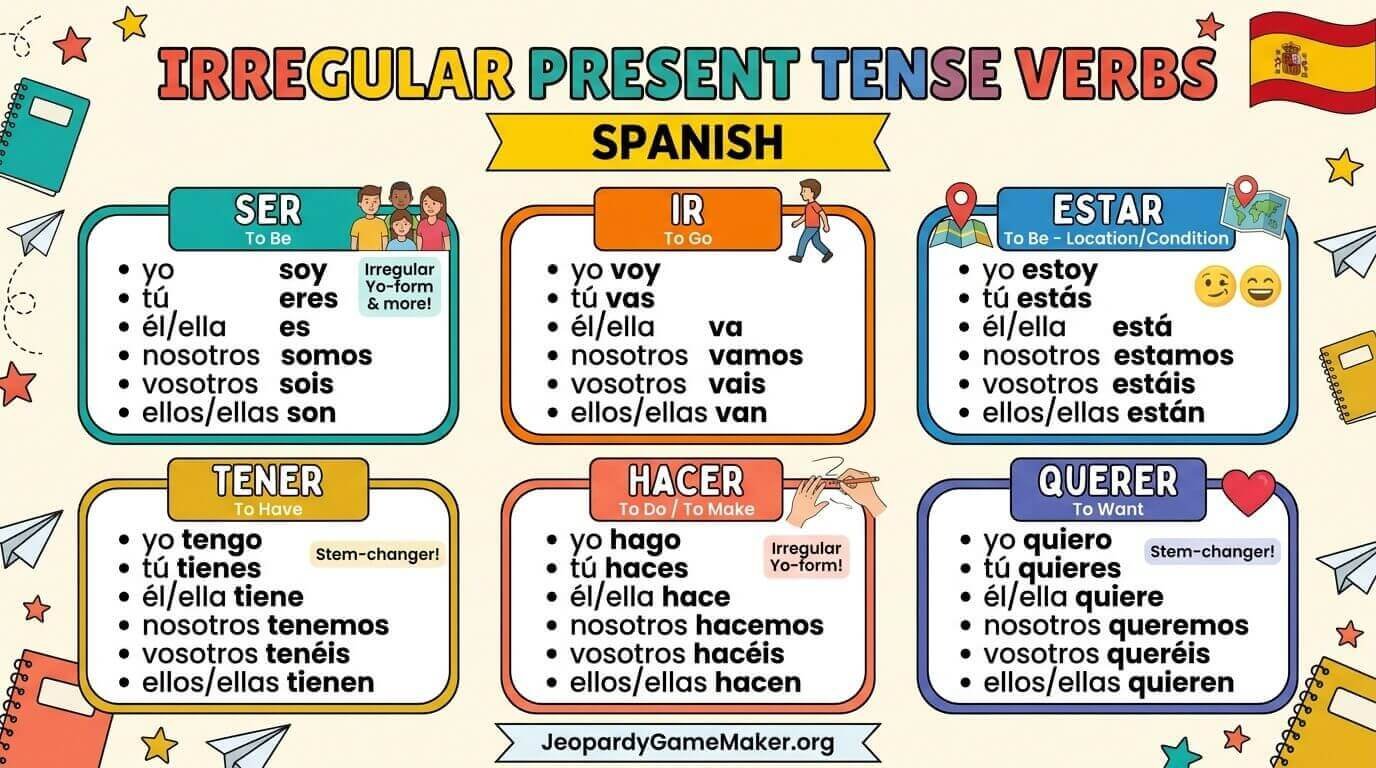
Irregular Verb Chart (Top 10)
| Verb | yo | tú | él / ella | nosotros | vosotros | ellos / ellas |
|---|---|---|---|---|---|---|
| ser (to be) | soy | eres | es | somos | sois | son |
| estar (to be) | estoy | estás | está | estamos | estáis | están |
| ir (to go) | voy | vas | va | vamos | vais | van |
| tener (to have) | tengo | tienes | tiene | tenemos | tenéis | tienen |
| hacer (to do/make) | hago | haces | hace | hacemos | hacéis | hacen |
| decir (to say) | digo | dices | dice | decimos | decís | dicen |
| querer (to want) | quiero | quieres | quiere | queremos | queréis | quieren |
| poder (can) | puedo | puedes | puede | podemos | podéis | pueden |
| ver (to see) | veo | ves | ve | vemos | veis | ven |
| dar (to give) | doy | das | da | damos | dais | dan |
How to Learn Irregular Verbs Faster
- Group, do not memorise one by one. Learn all the “-go” verbs together, then the “-zco” verbs, then each stem-change type.
- Start with the top 10. Ser, estar, ir, tener, hacer, decir, querer, poder, ver and saber appear in almost every conversation.
- Remember the boot. If nosotros or vosotros, the stem stays normal.
- Practise out loud. Say “yo tengo, tú tienes, él tiene” until it sounds natural.
- Write personal sentences. “Yo voy al trabajo,” “Yo tengo hambre.” Real context sticks.
- Review a little every day. Ten minutes daily beats one long weekly session.
Common Mistakes With Spanish Irregular Verbs
- Over-regularising: saying hacio instead of hago, or sabo instead of sé.
- Stem-changing nosotros: puedemos is wrong; the correct form is podemos.
- Mixing ser and estar: ser usually describes identity and permanent traits; estar describes location and condition.
- Forgetting accents: sé (I know) versus se (pronoun), and está versus esta (this).
- Using the wrong irregularity: tengo and vengo use “g”, but quiero and puedo only change the stem.
Practice: 15 Irregular Present Tense Questions
Write the correct present tense form of each verb in parentheses. Check the answers below when you finish.
- Yo (hacer) la cena.
- Tú (poder) venir a mi casa.
- Nosotros (querer) café.
- Ella (tener) dos hermanos.
- Ellos (ir) al cine.
- Yo (conocer) a María.
- Usted (pedir) una pizza.
- Nosotros (jugar) al fútbol.
- Yo (saber) la respuesta.
- Ustedes (estar) en casa.
- Yo (oír) música.
- Ella (decir) la verdad.
- Tú (ser) muy amable.
- Yo (construir) una casa.
- Yo (salir) a las ocho.
Answers
1. hago | 2. puedes | 3. queremos | 4. tiene | 5. van | 6. conozco | 7. pide | 8. jugamos | 9. sé | 10. están | 11. oigo | 12. dice | 13. eres | 14. construyo | 15. salgo
Final Thoughts
Irregular Present Tense Verbs Spanish look scary, but they are far more organised than they first appear.
Learn the five patterns, memorise the top 10 verbs and practise a little every day. Soon, tengo, voy, puedo and quiero will come out without thinking.
Ready to practise? Bookmark this chart, take the 15-question test again tomorrow and watch your accuracy rise!
FAQs
1. What are irregular present tense verbs in Spanish?
They are verbs that do not follow the regular -ar, -er and -ir present tense endings. They may have a special yo form, a stem change or completely different forms, like ser and ir.
2. How many irregular verbs are there in Spanish?
There are many, but most follow patterns. The core group you need for everyday speech is about 15 to 20 verbs, plus the stem-changing families.
3. What are the most common irregular verbs in Spanish?
Ser, estar, ir, tener, hacer, decir, venir, querer, poder, saber and ver are among the most frequently used.
4. What are stem-changing verbs in Spanish?
They are verbs where the stem vowel changes in most present tense forms: e to ie, o to ue, e to i or u to ue. The nosotros and vosotros forms keep the normal stem.
5. What are irregular yo verbs in Spanish?
They are verbs that are irregular only in the yo form, such as hago, pongo, salgo, conozco, doy and sé.
6. What is the difference between ser and estar?
Both mean “to be.” Ser is generally used for identity, origin, profession and lasting traits. Estar is used for location, feelings, and temporary states.
7. Why is the nosotros form regular in stem-changing verbs?
In nosotros and vosotros forms, the stress falls on the ending, not on the stem, so the stem vowel does not change.
8. What is the best way to practise irregular verbs?
Group verbs by pattern, say full conjugations aloud, write your own sentences and play short games or quizzes daily.
Short Practice Examples
Read each sentence and say the verb form out loud. Each sentence uses a verb from the chart above.
- Yo soy estudiante. (I am a student.)
- Tú vas a la escuela. (You go to school.)
- Nosotros tenemos dos libros. (We have two books.)
- Ella está en casa. (She is at home.)
- Yo quiero café. (I want coffee.)
- Ellos pueden jugar al fútbol. (They can play football.)
Now try your own: change the subject in each sentence and say the new verb form, for example, change Yo soy to Ella es.
2 thoughts on “Irregular Present Tense Verbs Spanish: Chart & Practice”