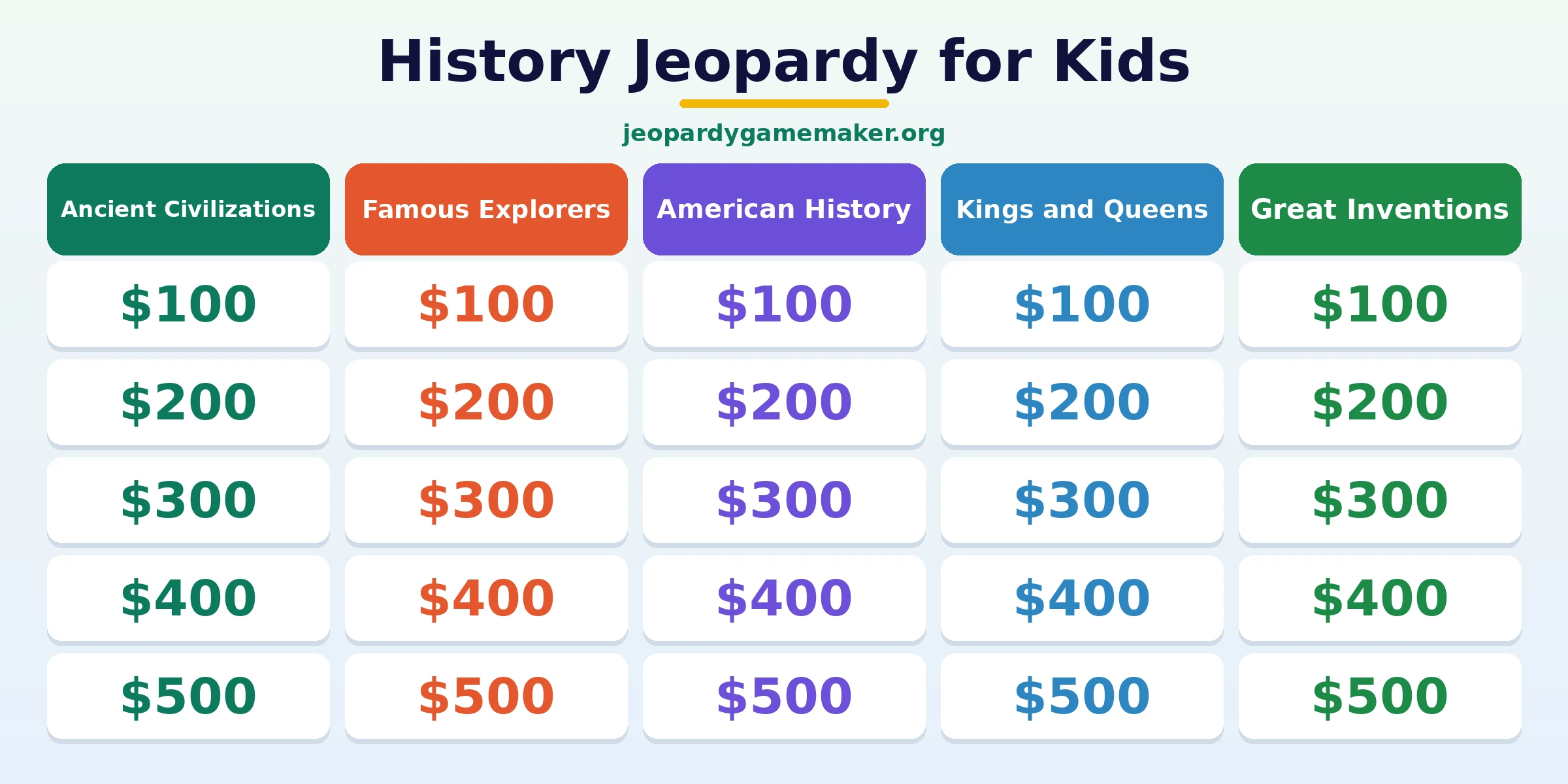
If your class is learning about the past, history jeopardy for kids gives you a ready way to test what students know about ancient civilizations, famous explorers, American history, kings and queens and great inventions in one lively game.
History works so well as a quiz because it is full of real people, real places and real events. One student knows the ancient Romans, another knows the explorers, and a third can name the kings and queens.
That shared knowledge makes the game fair and fun, and even a wrong answer starts a conversation about a famous person or a long ago event.
This article gives you a full board to copy, clear hosting steps, and honest notes about the free maker.
Why History Jeopardy for Kids Makes a Great Classroom Game
History is built from clear facts that suit quiz clues. Each person has a name and a story. Each place has a look and a past. Each event has a date and a cause.
That clarity keeps arguments short. When a clue asks which explorer sailed in 1492, the answer is one name.
The five categories also cover different kinds of fans. One student may know the ancient world best. Another may know the explorers. A third may know the kings and queens.
The topic also works across ages. Younger students enjoy the famous names and the fun places. Older students enjoy the harder dates and the tricky invention clues.
A history game also builds friendly rivalry without a lecture, since arguing about who built the Great Wall is really about maps, trade and smart choices.
How the Game Works
Split the class into two to four teams. Each team picks a category and a point value, from 100 to 500.
Read the clue aloud, give teams a short time to answer, then reveal the answer and add the points. The team with the highest score at the end wins.
Keep the pace brisk. If a team is stuck, move on quickly and let the next team pick. A slow game loses energy fast.
Use the low rows first with younger students, so the 100 and 200 clues build confidence before the harder rows.
For older students, play the full board. The 400 and 500 clues test real knowledge, and they often decide a close game.
Let students answer in the form of a question if you like that classic style. It is not required, but many classes enjoy the extra challenge.
A Sample Classroom Board
The board below is ready to copy. It has five categories and five point values, making 25 clues in total. Use it as it is, or swap any clue for one from your own lesson.
| Points | Ancient Civilizations | Famous Explorers | American History | Kings and Queens | Great Inventions |
|---|---|---|---|---|---|
| $100 | Clue: This ancient city built a huge round arena where gladiators fought. Answer: What is Rome? | Clue: This explorer sailed across the Atlantic in 1492 and reached the Americas. Answer: Who is Christopher Columbus? | Clue: This man was the first president of the United States. Answer: Who is George Washington? | Clue: This English queen ruled for 45 years and her time is called the Golden Age. Answer: Who is Queen Elizabeth I? | Clue: This round thing helps carts and cars roll along. Answer: What is the wheel? |
| $200 | Clue: This ancient land held the first Olympic Games. Answer: What is Greece? | Clue: This explorer led the first trip to sail all the way around the world. Answer: Who is Ferdinand Magellan? | Clue: This paper was signed in 1776 and said the colonies were free from Britain. Answer: What is the Declaration of Independence? | Clue: This queen of Britain ruled for 63 years in the 1800s. Answer: Who is Queen Victoria? | Clue: This machine printed books quickly and was built by Johannes Gutenberg. Answer: What is the printing press? |
| $300 | Clue: This long wall in China was built to keep out invaders. Answer: What is the Great Wall of China? | Clue: This traveler from Venice wrote a famous book about his long trip to China. Answer: Who is Marco Polo? | Clue: This president ended slavery in the United States during the Civil War. Answer: Who is Abraham Lincoln? | Clue: This king of France was called the Sun King and built a grand palace at Versailles. Answer: Who is King Louis XIV? | Clue: This bright idea from Thomas Edison lights up our homes. Answer: What is the light bulb? |
| $400 | Clue: This ancient people of Mexico built stepped pyramids and a famous calendar. Answer: Who are the Maya? | Clue: This Portuguese sailor found a sea route to India in 1498. Answer: Who is Vasco da Gama? | Clue: This tall statue was a gift from France and stands in New York Harbor. Answer: What is the Statue of Liberty? | Clue: This queen of Spain helped pay for the trip of Columbus in 1492. Answer: Who is Queen Isabella? | Clue: This invention lets us talk to people far away using wires and sound. Answer: What is the telephone? |
| $500 | Clue: This city in Mexico was the capital of the Aztec Empire and had canals like streets. Answer: What is Tenochtitlan? | Clue: These two explorers crossed North America to the Pacific with help from Sacagawea. Answer: Who are Lewis and Clark? | Clue: This first English settlement in America was started in Virginia in 1607. Answer: What is Jamestown? | Clue: This king signed the Magna Carta in 1215, limiting the power of English kings. Answer: Who is King John? | Clue: These two brothers built the first airplane to fly in 1903. Answer: Who are the Wright brothers? |
The board is balanced on purpose. Ancient civilizations and explorers are friendly starting points, while kings and queens and inventions reward students who know history closely.
For a full lesson, play all 25 clues. That usually takes 30 to 40 minutes, including team talk and answer reveals.
How to Build Your Own History Jeopardy Board
Start from a ready-made template if you want a head start, then change the categories to fit your lesson. You can keep the history categories or add your own, such as wars, artists, scientists or the space race.
Write short clues, not long paragraphs. Each clue should point to one clear answer, so teams can discuss it without getting lost.
Mix easy and hard clues in every category. If every clue is hard, weaker teams give up. If every clue is easy, strong teams get bored.
Keep answers short and clear. One name or one place works best, and it avoids arguments about what counts as correct.
For more board ideas, browse the Math Jeopardy board to see how a different subject is laid out, then copy that structure for history.
Hosting Tips That Keep the Game Moving
Appoint one student as scorekeeper. That frees you to read clues, manage turns and keep the pace lively.
Set a time limit for each answer. Ten to fifteen seconds is enough for most clues, and it keeps the room alert.
Read each clue twice if the room is noisy, so students hear it clearly before they start debating.
Give every team a fair turn. If one team dominates, let the next team pick the category, even if they did not answer last.
Use the board as a review, not a test. Praise good reasoning, even when the final answer is wrong.
End with the highest rows if time runs short. The 500 clues make a strong finish, and students remember the game better that way.
You can find more topic ideas on the Jeopardy games by topic page, which groups boards by subject for classroom use.
What This Maker Cannot Do
Honesty matters, so here are the limits in plain words. The maker is browser-based, which means you open it in a web browser and play it there.
You do not need to download anything, and you do not need to sign up for an account to build and play a board. That keeps setup fast in a classroom.
There is no native app to install on a phone or tablet. If you want an app store game, this maker is not that product.
There are no phone buzzers built into the maker. Teams answer aloud, or the host can use a simple hand raise, a bell or a chat message for remote play.
There is no downloadable slide template offered here. You build and play the board in the browser, and you can share it by link instead.
There is no native Zoom integration built into the maker. You can still share your screen on a video call, but the game itself runs in the browser.
These limits are also strengths in a school setting, since fewer tools mean fewer things can go wrong before a lesson.
If you need step by step setup help, the how-to guide walks through choosing topics, writing clues, entering them in the maker, previewing and playing with teams.
What to do next
Pick the sample board above and play it once with your class. One real game will show you which categories need easier clues and which need harder ones.
Then build your own history board with people and events from the next unit your class studies. Keep the five categories, or swap one for wars, artists or scientists.
Final Thoughts
History gives teachers a rare mix: real people, real places and stories students already care about. That mix makes it one of the best topics for a classroom quiz game.
A good board does not need fancy tools. It needs short clues, fair levels, a brisk pace and a host who keeps every team involved.
Use the sample board, adapt it to your class, and let students learn by playing. A lively quiz makes them look forward to the next game.
FAQs
1. Is history jeopardy good for younger students?
Yes, if you use the lower rows first. The 100 and 200 clues use simple facts, and you can skip the harder clues until students are ready.
2. Which history clues should I start with?
Start with explorers and inventions, because most students know those first. Add the ancient civilizations and kings and queens only when the class is comfortable with the first two.
3. Can I change the history clues for my class?
Yes. Keep the five categories, but swap any clue for one your class is studying now. Short clues and one clear answer per clue work best.
4. Do students need to know all the dates to play?
No. The lower rows use famous names like Columbus and the Wright brothers, so new students can play too. The higher rows reward students who know the dates and details closely.
5. Do students need an account or a download to play?
No. The maker runs in a browser, with no download and no signup needed to build and play a board. Students simply watch the shared board and answer aloud as teams.
6. Can I play this game over a video call?
Yes. Share your screen so all players can see the board, read clues aloud, and let teams answer by voice or chat. Keep turns short and appoint a scorekeeper so the game stays smooth.