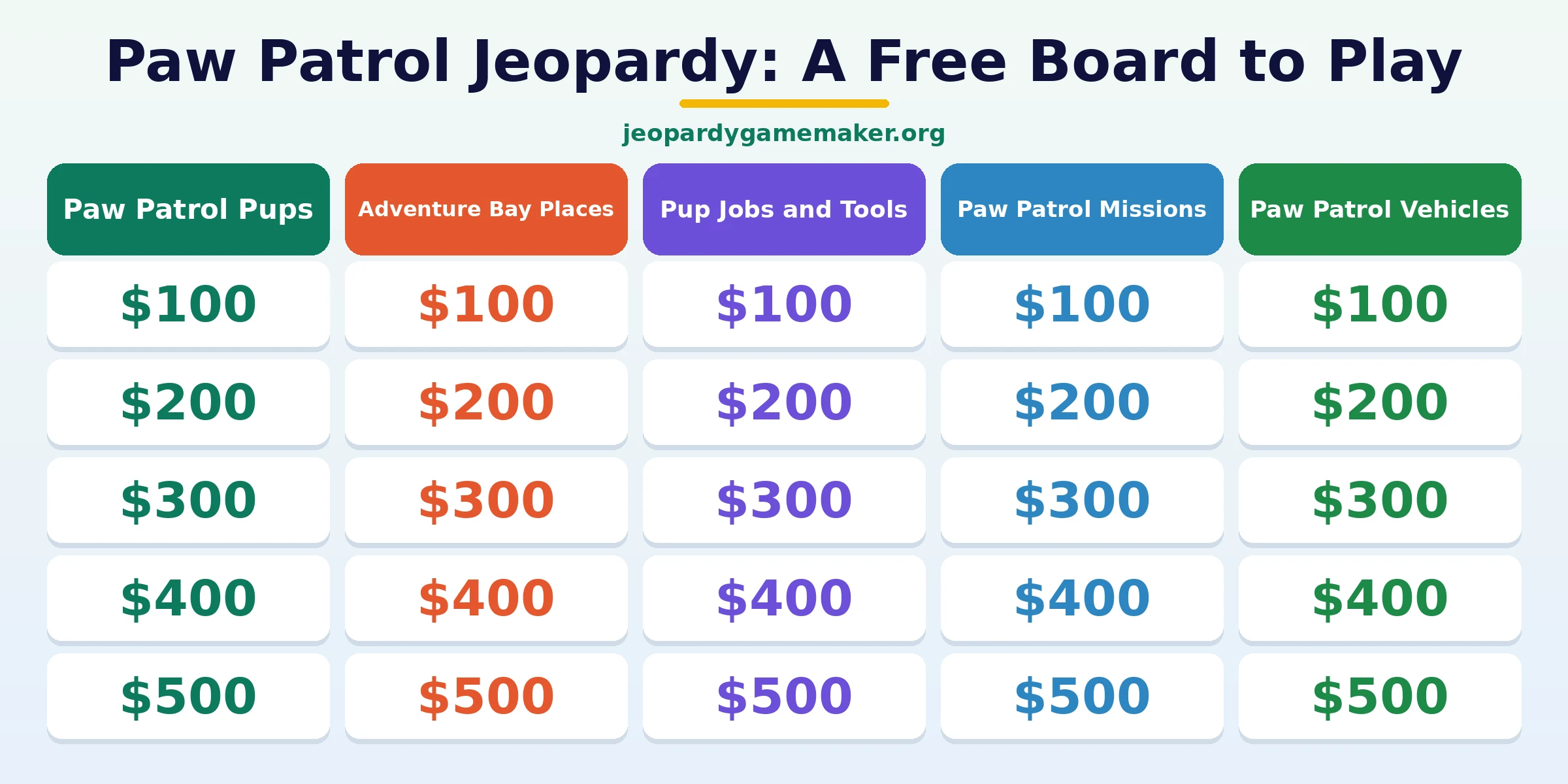
If your class loves brave pups, rescue missions and a town called Adventure Bay, paw patrol jeopardy gives you a ready way to test what students know about Chase, Marshall, Skye, Ryder and the famous pups in one lively game.
Paw Patrol works so well as a quiz because almost every student already knows it. One student can name every pup, another knows each pup’s job, and a third can list the vehicles they drive.
That shared knowledge makes the game fair and fun, and even a wrong answer starts a debate about which pup is the bravest.
This article gives you a full board to copy, clear hosting steps, and honest notes about the free maker.
Why Paw Patrol Jeopardy Makes a Great Quiz Game
Paw Patrol is built from clear facts that suit quiz clues. Each pup has a name, a job and a vehicle. Each mission has a clear problem and a clear rescue.
That clarity keeps arguments short. When a clue asks which pup is the police pup, the answer is one name.
The five categories also cover different kinds of fans. One student may know the pups best. Another may know Adventure Bay. A third may know the vehicles and the missions.
The topic also works across ages. Younger students enjoy the famous pups and the fun vehicles. Older students enjoy the harder mission and tool clues.
A Paw Patrol game also builds friendly rivalry without a lecture, since arguing about the best pup is really about memory and teamwork.
Teachers like the topic too, because it turns watching and memory into a game. Students recall facts from the show and want to prove it.
How the Game Works
Split the class into two to four teams. Each team picks a category and a point value, from 100 to 500.
Read the clue aloud, give teams a short time to answer, then reveal the answer and add the points. The highest score at the end wins.
Keep the pace brisk. If a team is stuck, move on quickly and let the next team pick. A slow game loses energy fast.
Use the low rows first with younger students, so the 100 and 200 clues build confidence before the harder rows.
For older students, play the full board. The 400 and 500 clues test real knowledge, and they often decide a close game.
Let students answer in the form of a question if you like that classic style. Many classes enjoy the extra challenge.
You can also add a debate round. Each team defends its favorite pup for bonus points.
A Sample Classroom Board
The board below is ready to copy. It has five categories and five point values, making 25 clues in total. Use it as it is, or swap any clue for one from your own lesson.
The mix covers pups, places and missions, so fans of every part of the show get their moment. The vehicle clues reward students who know the show closely.
| Points | Paw Patrol Pups | Adventure Bay Places | Pup Jobs and Tools | Paw Patrol Missions | Paw Patrol Vehicles |
|---|---|---|---|---|---|
| $100 | Clue: This German Shepherd is the police pup and the leader on missions. Answer: Who is Chase? | Clue: This is the name of the town where the Paw Patrol lives and works. Answer: What is Adventure Bay? | Clue: This is the name of the boy who leads the Paw Patrol. Answer: Who is Ryder? | Clue: This is the phrase Ryder says when a pup is needed for a mission. Answer: What is “Paw Patrol, to the Lookout”? | Clue: This pup drives a red fire truck with a ladder. Answer: Who is Marshall? |
| $200 | Clue: This Dalmatian pup is the firefighter and loves to laugh. Answer: Who is Marshall? | Clue: This tall tower is where the pups meet and where Ryder gives missions. Answer: What is the Lookout? | Clue: This pup uses a water cannon and works as a firefighter. Answer: Who is Marshall? | Clue: This is what the pups say when they are ready for action. Answer: What is “Paw Patrol is on a roll”? | Clue: This pup flies a pink helicopter and loves to do flips in the sky. Answer: Who is Skye? |
| $300 | Clue: This Cockapoo pup flies a helicopter and is the air rescue pup. Answer: Who is Skye? | Clue: This cafe in Adventure Bay is run by Mr. Porter. Answer: What is Mr. Porter’s Cafe? | Clue: This pup digs with a bulldozer and builds things around town. Answer: Who is Rubble? | Clue: This pup rescues animals and uses a hovercraft on the water. Answer: Who is Zuma? | Clue: This pup drives a blue police car with a megaphone. Answer: Who is Chase? |
| $400 | Clue: This English Bulldog pup builds and fixes things with his tools. Answer: Who is Rubble? | Clue: This is the name of the mountain where the pups go for snow rescues. Answer: What is Jake’s Mountain? | Clue: This pup is the police pup and uses a net launcher on missions. Answer: Who is Chase? | Clue: This pup joins the team for snow rescues on Jake’s Mountain. Answer: Who is Everest? | Clue: This pup drives a yellow bulldozer for construction jobs. Answer: Who is Rubble? |
| $500 | Clue: This chocolate Labrador pup loves water and drives a hovercraft. Answer: Who is Zuma? | Clue: This is the name of the island where the pups go for sea rescues. Answer: What is Seal Island? | Clue: This pup uses a snowplow and works as the snow rescue pup. Answer: Who is Everest? | Clue: This is the name of the mayor of Adventure Bay. Answer: Who is Mayor Goodway? | Clue: This pup drives an orange hovercraft that works on land and water. Answer: Who is Zuma? |
The board is balanced on purpose. Pups and places are friendly starting points, while the jobs and mission clues reward students who know the show closely.
For a full lesson, play all 25 clues. That usually takes 30 to 40 minutes, including team talk and answer reveals.
How to Build Your Own Paw Patrol Jeopardy Board
Start from a ready-made template if you want a head start, then change the categories to fit your lesson. Keep the Paw Patrol categories, or add songs, new pups, seasons or famous episodes.
Write short clues, not long paragraphs. Each clue should point to one clear answer.
Use pups and episodes your class has watched.
Mix easy and hard clues in every category. Hard clues alone make weaker teams give up, and easy clues alone bore strong teams.
Keep answers short and clear. One name or one place works best, and it avoids arguments about what counts as correct.
For more board ideas, browse the Math Jeopardy board to see how a different subject is laid out, then copy that structure for Paw Patrol.
Hosting Tips That Keep the Game Moving
Appoint one student as scorekeeper. That frees you to read clues and manage turns.
Set a time limit for each answer. Ten to fifteen seconds is enough for most clues, and it keeps the room alert.
Read each clue twice if the room is noisy, so students hear it clearly.
Give every team a fair turn. If one team dominates, let the next team pick the category.
Use the board as a review, not a test. Praise good reasoning, even when the final answer is wrong.
End with the highest rows if time runs short. The 500 clues make a strong finish, and students remember the game better that way.
You can find more topic ideas on the Jeopardy games by topic page, which groups boards by subject for classroom use.
What This Maker Cannot Do
Honesty matters, so here are the limits in plain words. The maker is browser-based, which means you open it in a web browser and play it there.
You do not need to download anything, and you do not need to sign up for an account to build and play a board. That keeps setup fast in a classroom.
There is no native app to install on a phone or tablet.
There are no phone buzzers built into the maker. Teams answer aloud, or the host can use a simple hand raise, a bell or a chat message for remote play.
There is no downloadable slide template offered here. You build and play the board in the browser, and you can share it by link instead.
There is also no native Zoom integration built into the maker. You can still play over a video call by sharing your screen, but the maker itself does not connect to Zoom.
These limits are also strengths in a school setting, since fewer tools mean fewer things can go wrong.
If you need step by step setup help, the how-to guide walks through choosing topics, writing clues, entering them in the maker, previewing and playing with teams.
What to do next
Pick the sample board above and play it once with your class. One real game will show you which categories need easier clues and which need harder ones.
Then build your own Paw Patrol board with pups from the next episode your class watches. Keep the five categories, or swap one for songs, vehicles or new pups.
Finally, try a second cartoon topic next term. Paw Patrol pairs well with other cartoon quizzes.
Final Thoughts
Paw Patrol gives teachers a rare mix: clear facts, beloved pups and stories students already care about. That mix makes it one of the best quiz topics for a classroom.
A good board does not need fancy tools. It needs short clues, fair levels and a brisk pace.
Use the sample board, adapt it to your class, and let students learn by playing. A lively quiz makes them look forward to the next game.
FAQs
1. Is paw patrol jeopardy good for younger students?
Yes, if you use the lower rows first. The 100 and 200 clues on pups and places use simple facts, and you can skip the harder mission and vehicle clues until students are ready.
2. Which Paw Patrol clues should I start with?
Start with Paw Patrol Pups and Adventure Bay Places, because most students know those first. Add the rest only when the class is comfortable.
3. Can I change the Paw Patrol clues for my class?
Yes. Keep the five category structure, but swap any clue for one your class is watching now, such as a new episode or pup. Short clues and one clear answer per clue work best.
4. Do students need to know all the Paw Patrol episodes to play?
No. The lower rows use famous names like Chase and Marshall, so new students can play too. The higher rows reward students who know the missions and the vehicles closely.
5. Do students need an account or a download to play?
No. The maker runs in a browser, with no download and no signup needed to build and play a board. Students simply watch the shared board and answer aloud as teams.
6. Can I play this game over a video call?
Yes. Share your screen so all players can see the board, read clues aloud, and let teams answer by voice or chat. Keep turns short and appoint a scorekeeper so the game stays smooth.