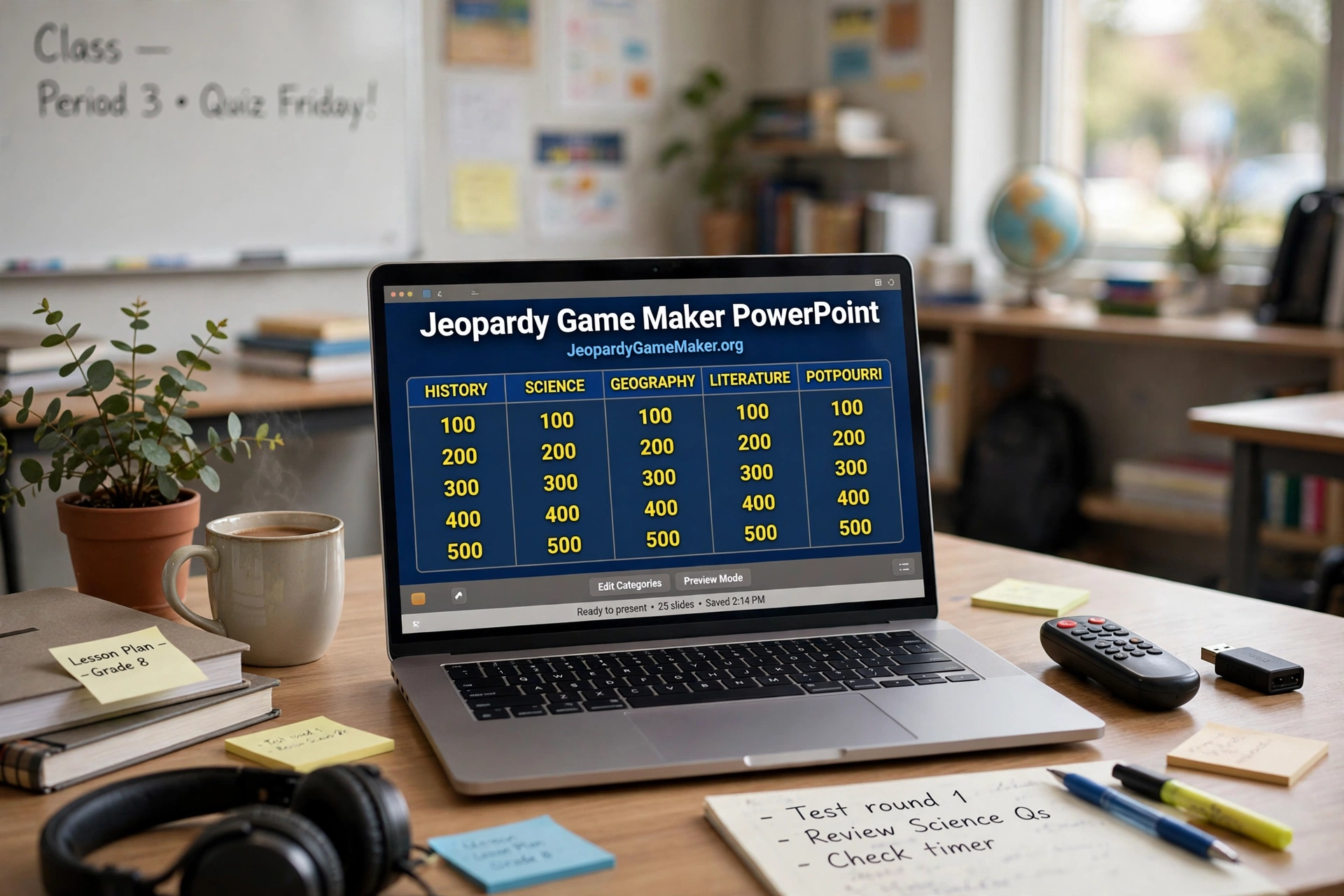
If you like building slides, a jeopardy game maker powerpoint board is a fun project, and a free browser maker is a faster way to play the same game.
This article shows you both paths. First, how to build a board in PowerPoint step by step, then how to play the same game in a browser with no download and no signup.
You also get a full board to copy, with 25 clues ready to use in class or at a party.
Why Jeopardy Game Maker PowerPoint Makes a Great Quiz Game
A PowerPoint board works because teachers already know the program. You build slides, add links, and play it on the same screen you use for lessons.
That comfort keeps the game under your control. You can add your own pictures, fonts and sounds, and you can keep the file on your own computer.
The five categories also let you cover a whole lesson in one game. One column can be landmarks, one can be maths, one can be animals, and the rest can be films and slides.
The game also works across ages. Younger students enjoy the easy rows and the team cheering. Older students enjoy the harder rows and the close scores.
How the Game Works
Split the class into two to four teams. Each team picks a category and a point value, from 100 to 500.
Read the clue aloud, give teams a short time to answer, then reveal the answer and add the points. The highest score at the end wins.
In PowerPoint, each tile is a link to a clue slide. Click a tile, read the clue, then click back to the board to pick the next tile.
Keep the pace brisk. If a team is stuck, move on quickly and let the next team pick. A slow game loses energy fast.
Use the low rows first with younger students, so the 100 and 200 clues build confidence before the harder rows.
For older students, play the full board. The 400 and 500 clues test real knowledge, and they often decide a close game.
A Sample Classroom Board
The board below is ready to copy. It has five categories and five point values, making 25 clues in total. Use it as it is, or swap any clue for one from your own lesson.
The mix covers PowerPoint basics, landmarks, maths, animals and movie night, so every player finds a column they like. The PowerPoint column teaches the tool as you play.
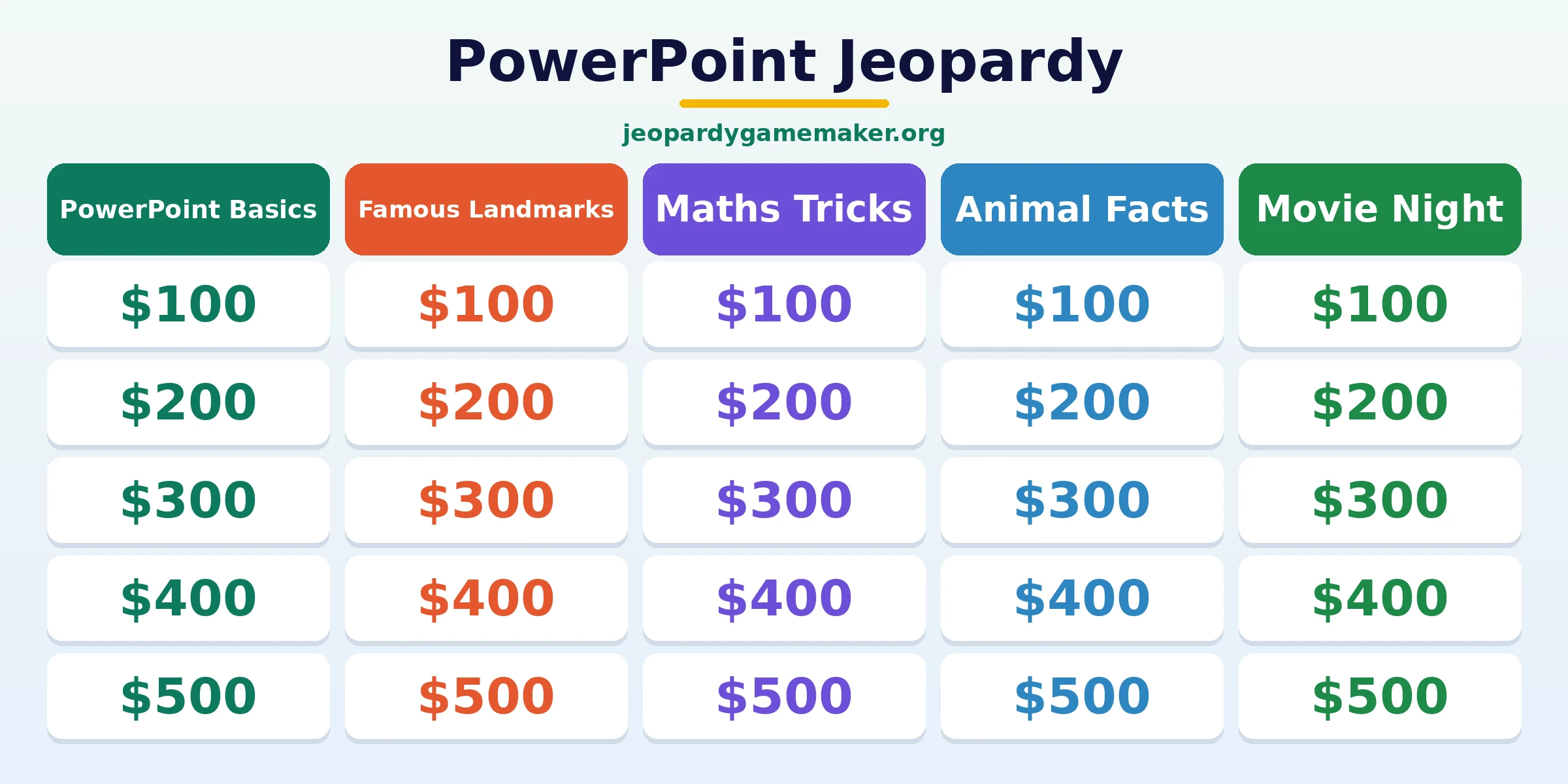
| Points | PowerPoint Basics | Famous Landmarks | Maths Tricks | Animal Facts | Movie Night |
|---|---|---|---|---|---|
| $100 | Clue: This is the tab where you add a new slide. Answer: What is the Home tab? | Clue: This tower stands in Paris. Answer: What is the Eiffel Tower? | Clue: What is 7 plus 8? Answer: What is 15? | Clue: This animal is the largest mammal in the sea. Answer: What is a blue whale? | Clue: This ogre lives in a swamp. Answer: Who is Shrek? |
| $200 | Clue: This is what you change to make text bigger. Answer: What is the font size? | Clue: This wall stands in China. Answer: What is the Great Wall of China? | Clue: What is 9 times 9? Answer: What is 81? | Clue: This is a baby cat. Answer: What is a kitten? | Clue: This lion is the king of the Pride Lands. Answer: Who is Simba? |
| $300 | Clue: This feature lets one slide jump to another when you click. Answer: What is a hyperlink? | Clue: This statue stands in New York harbour. Answer: What is the Statue of Liberty? | Clue: What is a quarter of 100? Answer: What is 25? | Clue: This animal changes colour to hide. Answer: What is a chameleon? | Clue: This snowman loves warm hugs. Answer: Who is Olaf? |
| $400 | Clue: This view shows all your slides as small pictures. Answer: What is Slide Sorter view? | Clue: This building in India is made of white marble. Answer: What is the Taj Mahal? | Clue: This is the next number after 99. Answer: What is 100? | Clue: This is the fastest land animal. Answer: What is a cheetah? | Clue: This toy cowboy is called Woody. Answer: Who is Woody? |
| $500 | Clue: This is the master slide that sets the design for the whole file. Answer: What is Slide Master? | Clue: This ancient arena stands in Rome. Answer: What is the Colosseum? | Clue: This shape has five sides. Answer: What is a pentagon? | Clue: This bird can mimic human speech. Answer: What is a parrot? | Clue: This is the name of the school where Harry Potter studies. Answer: What is Hogwarts? |
For a full lesson, play all 25 clues. That usually takes 30 to 40 minutes, including team talk and answer reveals.
How to Build Your Own Jeopardy Game Maker PowerPoint Board
Start from a ready-made template if you want a head start, then change the categories to fit your lesson. Keep the mixed columns, or add your own subject, your own class rules, or a topic from this week.
Build the board slide first. Make a table with six columns and six rows: one header row for the title and categories, and five rows for the point values.
Add one clue slide for each tile. That is 25 clue slides, each with the clue in big text and the answer hidden below it or on the next slide.
Link every tile to its clue slide, and link every clue slide back to the board. Without the return link, you will be stuck on a clue slide in front of the class.
Write short clues, not long paragraphs. Each clue should point to one clear answer.
Keep answers short and clear. One name, one number or one place works best, and it avoids arguments about what counts as correct.
For more board ideas, browse the Math Jeopardy board to see how a different subject is laid out, then copy that structure for your own lesson.
Hosting Tips That Keep the Game Moving
Appoint one student as scorekeeper. That frees you to read clues and manage turns.
Set a time limit for each answer. Ten to fifteen seconds is enough for most clues, and it keeps the room alert.
Give every team a fair turn. If one team dominates, let the next team pick the category.
Use the board as a review, not a test. Praise good reasoning, even when the final answer is wrong.
End with the highest rows if time runs short. The 500 clues make a strong finish, and students remember the game better that way.
You can find more topic ideas on the Jeopardy games by topic page, which groups boards by subject for classroom use.
PowerPoint vs a Browser Maker: Which One Fits Your Class
PowerPoint and a browser maker both play the same game, but they suit different days. PowerPoint gives you full design control.
You can pick your own fonts, colours, pictures and sounds, and the file stays on your own computer. That control is worth the extra build time when you will play the same board all year.
A browser maker is faster. You type the categories and clues, press play, and the board is ready. Tiles grey out after use, and scores add up on screen.
PowerPoint needs 25 clue slides and 25 links, plus return links, before the first game. That is a full planning period for one board.
The browser maker also needs no file to carry. Open the link on any classroom computer and play, even if your laptop stays at home.
Pick PowerPoint when you want a polished board you will reuse many times. Pick the browser maker when you need a game today.
Test Every Link Before Game Day: A Checklist
A PowerPoint board lives or dies by its links, so test them all before the class arrives. Click every tile and check that it opens the right clue.
Click the return link on every clue slide and check that it goes back to the board. One missing return link can stop the game in front of thirty students.
Check the fonts on the classroom computer, not just your own laptop. A font that is missing will change the whole look of your slides.
Check pictures and sounds too. A picture that is linked, not saved in the file, will show as a blank box on another computer.
Save a backup copy on a USB stick or in the cloud. If the classroom computer cannot open your file, the backup saves the lesson.
Finally, play one full round by yourself. Pick tiles in a random order, answer a few clues, and check the score. That one test run finds most problems before the class does.
What This Maker Cannot Do
Honesty matters, so here are the limits in plain words. The maker is browser-based, which means you open it in a web browser and play it there.
You do not need to download anything, and you do not need to sign up for an account to build and play a board. That keeps setup fast in a classroom.
There is no native app to install on a phone or tablet.
There are no phone buzzers built into the maker. Teams answer aloud, or the host can use a simple hand raise, a bell or a chat message for remote play.
There is no downloadable slide template offered here, and there is no PowerPoint export. You build and play the board in the browser, and you can share it by link instead.
There is also no native Zoom integration built into the maker. You can still play over a video call by sharing your screen, but the maker itself does not connect to Zoom.
These limits are also strengths in a school setting, since fewer tools mean fewer things can go wrong.
If you need step by step setup help, the how-to guide walks through choosing topics, writing clues, entering them in the maker, previewing and playing with teams.
What to do next
Pick the sample board above and play it once with your class. One real game will show you which categories need easier clues and which need harder ones.
Then build your own PowerPoint board from your next lesson, or build the same board in the browser maker and compare the two. Keep the five categories, or swap one for your subject, your class rules or a topic from this week.
Final Thoughts
A jeopardy game maker PowerPoint board earns its place because it is yours to design and yours to keep. The browser maker earns its place because it is ready in minutes.
Use the sample board, build it the way that fits your day, and let students learn by playing. A lively quiz makes them look forward to the next game.
FAQs
1. Can I make a Jeopardy game in PowerPoint for free?
Yes. You can build a board with a table, clue slides and hyperlinks in PowerPoint, and you can play it on a projector. It takes time to link every tile, but there is no extra cost.
2. Do I need a template download to build a PowerPoint board?
No. You can build the board from a blank presentation with a table and hyperlinks. This site does not offer a downloadable slide template, so build it yourself or use the free browser maker instead.
3. How many slides does a PowerPoint Jeopardy board need?
A full board needs 26 slides: one board slide and 25 clue slides. Add a title slide and a Final Jeopardy slide if you want them, and link every clue slide back to the board.
4. Can I use my own lesson questions in PowerPoint?
Yes. You can change every category and every clue to match your lesson. Keep the five category structure, use short clues, and keep one clear answer per clue.
5. Do students need an account or a download to play?
No. The browser maker runs in a browser, with no download and no signup needed to build and play a board. Students simply watch the shared board and answer aloud as teams.
6. Can I play a PowerPoint Jeopardy game over a video call?
Yes. Share your screen so all players can see the board, read clues aloud, and let teams answer by voice or chat. Keep turns short and appoint a scorekeeper so the game stays smooth.