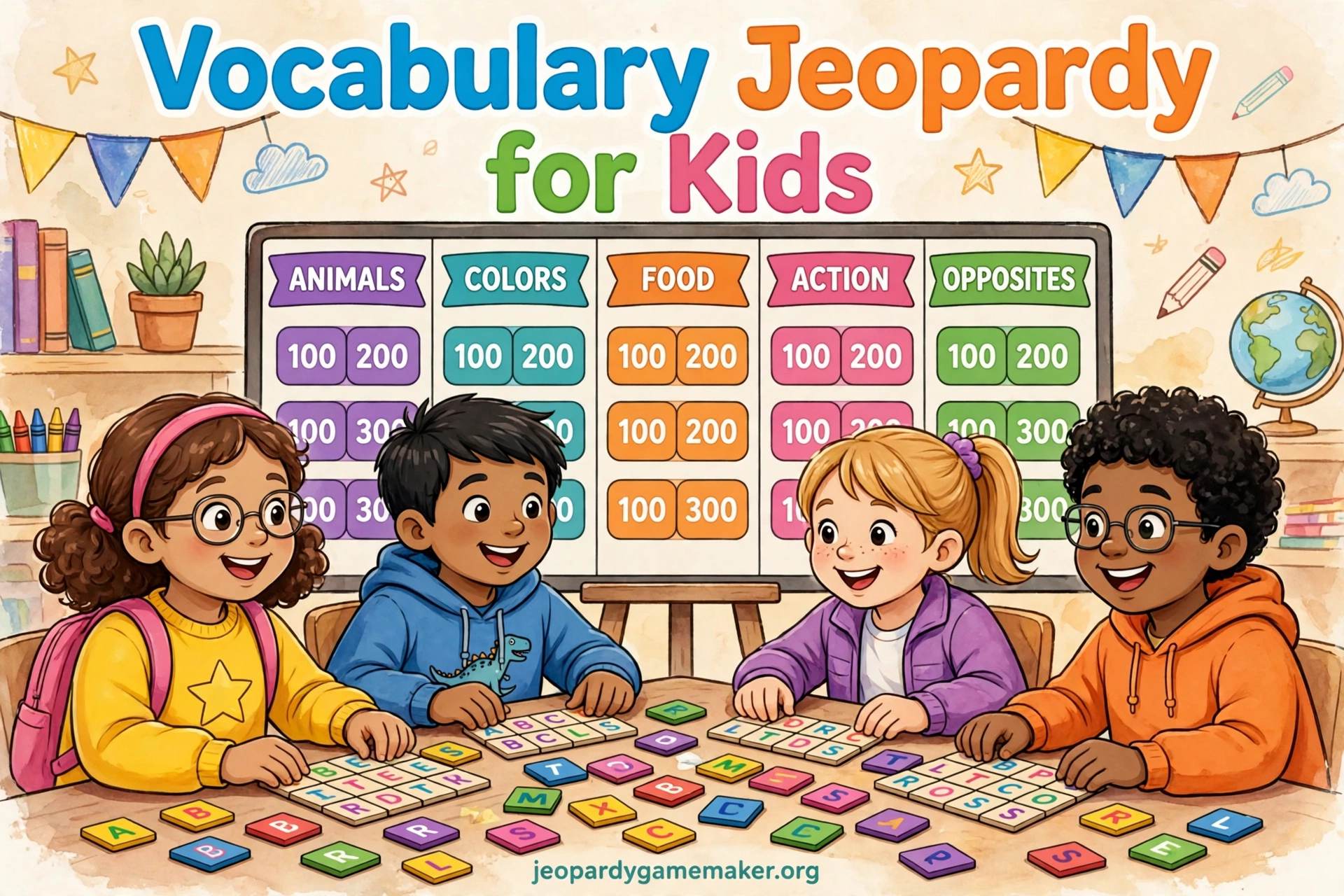
vocabulary jeopardy for kids game turns word practice into a team contest that children actually want to join.
Instead of a spelling list on paper, kids pick a tile, hear a clue, and race to say the word.
Every correct answer builds confidence, and every wrong guess still teaches a new word.
This guide gives you a ready board, simple rules, and age tips for class or home.
You do not need to download anything or create an account to start playing.
Why Word Games Work So Well for Kids
Children remember words better when they use them in a game than when they only read them.
A clue forces a child to think about meaning, sound, and spelling at the same time.
Team play adds gentle pressure, but it also lets shy kids learn from teammates.
A wrong answer is not a failure in this game, because the right word is revealed right away.
Teachers can reuse the same board for review, and parents can use it for homework practice.
Short rounds keep attention high, even for younger children with short focus spans.
The board format also helps kids learn categories, which is a useful reading skill.
When words are grouped by theme, children start to see how words connect to each other.
How the Game Works
The board has five categories and five point rows, from $100 to $500.
A team picks a category and a point value, then reads or hears the clue.
If the team answers correctly, it earns those points for its total score.
If the answer is wrong, another team can try, or the host can reveal the answer.
Higher point tiles should have harder words, so the game stays fair as it goes on.
The team with the most points at the end wins, but every team learns new words.
You can play with two to four teams, which works well for most classrooms.
For one child at home, play together as a team against a target score instead.
A Ready Sample Board You Can Copy
Use this board exactly as it is, or change any word to match your lesson.
The clues are short, and the answers are common words that kids meet in school.
Read the clue aloud for younger kids, and let older kids read the tile themselves.
| Points | Animals | Food Words | Opposites | Rhyming Words | Action Words |
|---|---|---|---|---|---|
| $100 | A pet that says meow. Answer: Cat | A red fruit that grows on a tree. Answer: Apple | The opposite of hot. Answer: Cold | A word that rhymes with cat. Answer: Hat | To move fast on your feet. Answer: Run |
| $200 | A big animal with a long trunk. Answer: Elephant | A yellow fruit monkeys love. Answer: Banana | The opposite of big. Answer: Small | A word that rhymes with sun. Answer: Fun | To jump up and down with joy. Answer: Hop |
| $300 | A bird that cannot fly but swims. Answer: Penguin | A food made from milk that melts on pizza. Answer: Cheese | The opposite of happy. Answer: Sad | A word that rhymes with light. Answer: Night | To look at words in a book. Answer: Read |
| $400 | An animal that changes color to hide. Answer: Chameleon | A green vegetable that looks like a small tree. Answer: Broccoli | The opposite of brave. Answer: Scared | A word that rhymes with chair. Answer: Bear | To write words with a pencil. Answer: Write |
| $500 | A sea animal with eight arms. Answer: Octopus | A grain food often served with curry or stir fry. Answer: Rice | The opposite of ancient. Answer: Modern | A word that rhymes with ocean. Answer: Motion | To find the meaning of a hard word. Answer: Define |
How to Use This Board in a Lesson
Start with the $100 row so every child gets an early win.
Move to harder rows only after the class has warmed up and feels safe.
Ask the answering team to use the word in a short sentence for bonus praise.
If a word is new, pause and explain it in one simple sentence before moving on.
Write new words on the classroom board so children can see and copy them.
End the game with a quick recap of five words the class found hardest.
That recap turns a fun game into real vocabulary revision without extra homework.
Running It in Class
Split the class into teams of four or five so everyone gets a turn to speak.
Give each team a captain who picks the tile, but let the whole team discuss.
Set a short time limit for each answer, about ten seconds for easy tiles.
For hard tiles, allow twenty seconds so kids can think and talk it through.
Use a visible score chart so teams can follow the game without asking.
If one team pulls far ahead, offer a comeback tile from the $500 row.
Keep the tone light, and praise good guesses even when the word is wrong.
A calm host makes the game fun for kids who are still building confidence.
Running It at Home
You can play this game at the kitchen table with one child or with siblings.
Let the child pick first, and start with categories they already enjoy.
Read clues aloud, and give a small hint if the child is stuck after a few seconds.
Keep the first game short, with only the $100 and $200 rows if needed.
After the game, ask your child to pick three favorite new words for the week.
Stick those words on the fridge so the family sees and uses them often.
For siblings, mix teams by age so younger kids are not always on the losing side.
A short game after homework feels like a reward, not like extra school work.
Age Tips That Keep It Fair
Younger kids need picture hints, spoken clues, and words they already know.
Older kids enjoy harder words, word roots, and clues that need more thinking.
Do not use the same hard words for a five year old and a ten year old.
Adjust the board by swapping only the hardest row when you change age groups.
| Age group | Best word focus | Example words | Game tip |
|---|---|---|---|
| Ages 5 to 6 | Animal names, colors, and simple actions | Cat, run, happy, apple | Read every clue aloud and give picture hints |
| Ages 7 to 8 | Opposites, rhymes, and food words | Cold, night, banana, hop | Let teams discuss for ten seconds before answering |
| Ages 9 to 10 | Harder nouns, verbs, and word meanings | Define, modern, chameleon, motion | Ask for a sentence using the word after a correct answer |
Make Your Own Board in Minutes
You can build a board around any word list your class is learning this week.
Start with five themes, then add five words to each theme from easy to hard.
A ready template can show you how a finished board looks before you start.
Keep clues short, and write the answer as one clear word whenever you can.
Avoid trick clues for young kids, because they punish guessing instead of rewarding learning.
Test your board once with a small group before you use it with a full class.
One test round will show you which clues are too easy and which are too hard.
You can reuse a good board all week, and only change a few words each day.
For more topic ideas, browse the Jeopardy games by topic page for classroom themes.
If you want a number themed board next, try a Math Jeopardy board for your class.
The full steps for building and playing are in the how-to guide on this site.
Troubleshooting Common Problems
If kids shout answers out of turn, make only the captain allowed to answer.
If one child dominates a team, rotate the captain role after every two tiles.
If the game feels too easy, swap in harder words for the $400 and $500 rows.
If the game feels too hard, drop back to the $100 and $200 rows for a round.
If the board loads slowly, refresh the page and open the game again.
If a team argues about a close answer, accept clear synonyms and move on fast.
Long arguments kill the fun, and the goal is learning words, not winning a debate.
If time runs out, stop at the current scores and name the leading team.
Honest Limits
This maker is browser based, so you need an internet connection to open it.
There is no download and no signup, which keeps setup fast for teachers.
There is no native app, so you open the game in a browser on any device.
There are no phone buzzers, so teams answer by speaking or raising a hand.
There is no downloadable slides template, so the game runs in the browser board.
There is no native Zoom integration, so online play needs screen sharing by the host.
These limits matter for planning, but they do not stop a normal classroom game.
A projector, a laptop, and a score chart are enough to run the full game.
What to do next
Open the sample board above and try one round with your class or family.
Note which words were too easy and which words need a simpler clue.
Build your next board around the words your kids missed in that first game.
Save the share link so you can open the same board again tomorrow.
Final Thoughts
A good vocabulary game does not need fancy tools or a long setup time.
It needs clear words, fair teams, and a host who keeps the game moving.
This board gives you all three, and you can adapt it for any age group.
Start with the sample board, then make it your own word by word.
FAQs
1. What age is vocabulary jeopardy for kids best for?
It works best for ages five to ten, with clues adjusted for each age group. Younger kids need spoken clues and simple words, while older kids enjoy harder words and sentence challenges.
2. Can I play vocabulary jeopardy for kids without an account?
Yes. The game runs in your browser with no download and no signup. You can open the board, play with teams, and share the link without creating an account.
3. How many teams can play at once?
Two to four teams work best, because every team gets enough turns. For one child at home, play together as a team and aim for a target score instead of competing.
4. Can I change the words on the sample board?
Yes. You can replace any clue or answer with words from your own lesson list. Keep five categories and five point rows, and order the words from easy to hard.
5. How long does a full game take?
A full 25 tile game takes about twenty to thirty minutes in class. For a short session, play only the $100 and $200 rows, which takes about ten minutes.
6. Is this game good for English learners?
Yes, because clues are short and answers are single common words. The host can explain each new word in one simple sentence, which helps learners build meaning and confidence.
1 thought on “Vocabulary Jeopardy for Kids: A Free Word Game Board to Play”