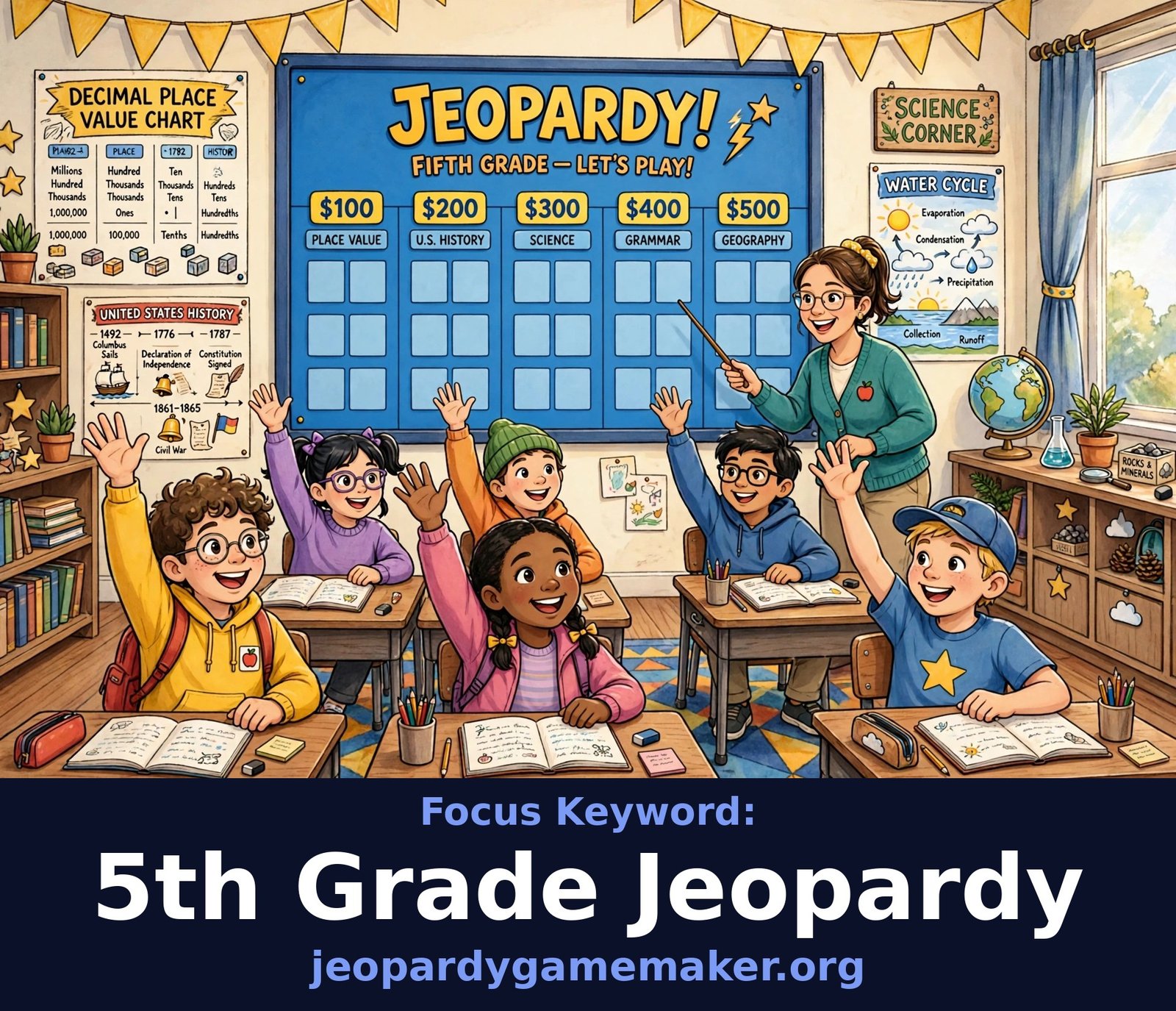
Fifth grade is the victory lap of elementary school. If your class is ready to show how far it has come, 5th grade jeopardy turns a year of big ideas into one big game, with decimals, volume, the water cycle, the Bill of Rights, and Greek roots all on the same board.
A quiet worksheet tells you what one student remembers. A team game shows you what a whole class can reason through together, and fifth graders reason like pros, with strategy, debate, and a healthy respect for the 500 point gamble.
This page gives you the complete game in two ways. First, the full board is written out below with every clue and every answer, so you can read it, print it, or play straight from this page. Second, you can open the free game maker and play the same board on your classroom screen with a few clicks.
Use it for end of unit review, for state test warm ups, or as a whole year championship game in the last week of school. There is nothing to download and no account to make.
Why Jeopardy Works for 5th Grade Review
Fifth graders have reached the top floor of elementary school, and the material shows it: adding fractions with different denominators, measuring volume, tracing the water cycle, and learning how their rights are protected. Review sticks when students have to pull an idea out of memory and defend it to their team, not just read it one more time.
The point ladder does quiet differentiation for you. The 100 and 200 point clues check the basics almost everyone has mastered, so every team banks early points. The 400 and 500 point clues reward the students who went deeper, and they usually decide the championship.
Teams also teach each other as they play. When a student explains to a teammate why one half plus one fourth equals three fourths, that explanation is review, tutoring, and confidence building all at once.
Best of all, the game makes test prep feel like a tournament instead of a chore. Students rehearse the exact skills you need them to remember, but they walk out talking about the comeback in the last round.
How to Play 5th Grade Jeopardy in the Classroom
Set up is simple. Divide the class into three to five teams, and mix strong and struggling students on every team. Let each team pick a name with some swagger, like the Decimal Dynamos or the Brainy Bunch.
Teams take turns choosing a category and a point value, from 100 to 500. Read the clue aloud, or show it on the big screen, and give the team about 30 seconds to talk it over and answer.
Keep one friendly rule: a wrong answer does not lose points. Fifth graders take real academic risks when a miss costs nothing, and the quiet students start volunteering ideas by the second round.
If a team is stuck, let the next team try to steal the points. Steals keep every team studying every clue, even when it is not their turn, because any clue might suddenly become theirs.
Let students answer in the classic question style, such as “What is 1,000?”, if your class likes the challenge. If the format slows the game down, accept a plain answer and keep the thinking front and center.
For a whole class, project the board and put one trusted scorekeeper at the whiteboard. For small groups, print the board from this page and let each table run its own game with a student as host.
5th Grade Jeopardy: The Full Game Board
The board below is ready to play as it is. It has five categories and five point values, making 25 clues in total, and every clue shows its answer right beside it. Play it from this page, or copy the clues into the free maker to play on a big screen.
| Points | Math Masters | Reading Detectives | Science Explorers | Social Studies Stars | Word Wizards |
|---|---|---|---|---|---|
| $100 | Clue: The value of 10 to the power of 3. Answer: What is 1,000? | Clue: The person or voice that tells a story to the reader is called this. Answer: What is the narrator? | Clue: The process by which green plants use sunlight, water, and air to make their own food. Answer: What is photosynthesis? | Clue: This document, signed in 1776, announced that the American colonies were free from Britain. Answer: What is the Declaration of Independence? | Clue: In the word unhappy, the prefix un means this. Answer: What is not? |
| $200 | Clue: The sum of 1/2 plus 1/4. Answer: What is 3/4? | Clue: When a writer compares two things using the word like or as, such as brave as a lion, it is this figure of speech. Answer: What is a simile? | Clue: The layer of gases that surrounds the Earth and gives us air to breathe. Answer: What is the atmosphere? | Clue: The first ten amendments to the United States Constitution are known by this name. Answer: What is the Bill of Rights? | Clue: Words that sound the same but have different meanings and different spellings, like their, there, and they’re. Answer: What are homophones? |
| $300 | Clue: A box is 3 units long, 2 units wide, and 4 units high. Its volume is this many cubic units. Answer: What is 24? | Clue: When you use clues in the text plus what you already know to guess what will happen next, you are making one of these. Answer: What is a prediction? | Clue: Water that falls from clouds as rain, snow, sleet, or hail is called this. Answer: What is precipitation? | Clue: This war, fought from 1861 to 1865, was between the Northern Union states and the Southern Confederate states. Answer: What is the Civil War? | Clue: The Greek root photo, as in the word photograph, means this. Answer: What is light? |
| $400 | Clue: Following the order of operations, the result of 8 plus 2 times 5. Answer: What is 18? | Clue: A nonfiction text that tells events in the order they happened, from first to last, is organized in this structure. Answer: What is chronological order? | Clue: This invisible force pulls objects toward the Earth and keeps the moon moving in orbit around it. Answer: What is gravity? | Clue: This system keeps any one branch of government from becoming too powerful, because each branch can limit the others. Answer: What is checks and balances? | Clue: A group of words with a subject and a verb that cannot stand alone as a complete sentence. Answer: What is a dependent clause? |
| $500 | Clue: On a coordinate grid, the point that sits 3 units to the right and 4 units up from the origin is written this way. Answer: What is (3, 4)? | Clue: Unlike a topic, which can be one or two words, this is a full sentence that states what a whole text is mostly about. Answer: What is the main idea? | Clue: In an ecosystem, these organisms break down dead plants and animals and return nutrients to the soil. Answer: What are decomposers? | Clue: In this 1803 deal, President Jefferson bought a huge territory from France, and the size of the United States doubled. Answer: What is the Louisiana Purchase? | Clue: When a writer gives human feelings or actions to an object, such as the wind whispered through the trees, it is this figure of speech. Answer: What is personification? |
Bonus Final Jeopardy: Category: United States Geography. Clue: This river, the longest in the United States, flows from Minnesota all the way down to the Gulf of Mexico. Answer: What is the Mississippi River?
Category by Category: What Each Column Reviews
Math Masters climbs the fifth grade math ladder in order: powers of ten, fraction addition with unlike denominators, volume of a box, the order of operations, and finally a coordinate point that students must write in the correct format.
Reading Detectives moves from naming the narrator to the hardest reading skill on the board, telling the main idea apart from a simple topic. The simile and prediction clues sit in the middle, where most state tests put them too.
Science Explorers crosses the big fifth grade units: life science with photosynthesis and decomposers, earth science with the atmosphere and precipitation, and a first step into space with gravity holding the moon in orbit.
Social Studies Stars tells the American story in order, from the Declaration of Independence and the Bill of Rights to the Civil War, and it ends with checks and balances and the Louisiana Purchase, the two ideas fifth graders find hardest to keep apart.
Word Wizards rewards careful readers: a simple prefix, tricky homophones, a Greek root, a dependent clause, and personification for the 500 point finish.
Round 2: Swap the Categories for Your Next Unit
One board is never enough for a fifth grade year. The same five by five grid works for every unit you teach, and swapping the categories takes only a few minutes in the maker.
Try these swaps through the year: Decimal Dash and Fraction Action for math units, States and Capitals for geography weeks, Rocks and Weather for earth science, and Book Club Battles for your current novel study.
Let the winning team from the last game pick one category for the next board. Students play harder when the board carries a category they chose themselves.
Keeping Score on Paper or the Whiteboard
Scoring is simple. Each team earns the point value of every clue it answers correctly, and the host keeps a running tally where everyone can see it.
On the whiteboard, draw one column per team and update it after every clue. On paper, a scorekeeper with a simple table does the same job and gives one student a trusted role.
For Final Jeopardy, let each team wager some or all of its points in secret before you read the clue. The wager is where the famous comebacks happen, so save it for the very end.
Tips for Teachers: Running a Smooth Game
Read each clue twice before the timer starts. Fifth graders listen better when they know the question is coming, and a second reading costs only a few seconds.
Set a visible timer, about 30 seconds per clue. A steady pace keeps the energy high and stops one strong team from dominating every discussion.
Rotate who speaks for each team. By the last round, every student should have given at least one answer out loud, and teams quickly learn to coach their quieter members.
End with two minutes of recap. Ask the class which clue surprised them most, and you will hear exactly which skills still need one more lesson before the test.
Make Your Own 5th Grade Jeopardy Game
The board on this page is a starting point, not a limit. Open the free game maker, type in your own categories, clues, and answers, and it builds a board that follows your lesson plans.
Keep the five by five grid and the 100 to 500 point ladder, and swap in any subject you are teaching, from decimal place value to the causes of the Civil War.
There is nothing to download and no account to create. Build the board, open it on your classroom screen, and play, or share it with a link so a substitute teacher or a study group at home can use it too.
More Games Kids Love
Building a full set of grade boards gives your school a review game for every year. Younger classes can start with our 3rd grade jeopardy board, then move up to 4th grade jeopardy before they reach this one.
For subject practice, our science jeopardy grade 5 game goes deeper into fifth grade science, and the jeopardy for kids page collects boards for every age in one place.
What This Maker Cannot Do
Honesty matters, so here are the limits in plain words. The maker is browser based, which means you open it in a web browser and play it there.
You do not need to download anything, and you do not need to sign up for an account to build and play a board. That keeps setup fast at school and at home.
There is no native app to install on a phone or tablet. If you want an app store game, this maker is not that product.
There are no phone buzzers built into the maker. Teams answer aloud, or the host can use a simple hand raise, a small bell, or a chat message for remote play.
These limits are also strengths in a classroom. No installs, no student accounts, and no extra tools mean fewer things can go wrong five minutes before the bell.
Final Thoughts
Fifth grade review covers a lot of ground, from fraction sums to the Louisiana Purchase. Faced as a stack of worksheets, that ground feels endless. Faced as a championship game, the same ground feels winnable.
A good board does not need fancy tools. It needs short clues, fair levels, teams that mix abilities, and a teacher who keeps the pace brisk and the mood kind.
Use the board on this page for your next review day, then build one for every unit that follows. By the last week of school, your students will be asking for one more rematch, and that is a sentence few teachers ever get to say.
FAQs
1. What subjects does this game cover?
The board covers five subjects: math (powers of ten, adding fractions, volume, order of operations, and coordinate points), reading (narrator, similes, predictions, text structure, and main idea), science (photosynthesis, the atmosphere, precipitation, gravity, and decomposers), social studies (the Declaration of Independence, the Bill of Rights, the Civil War, checks and balances, and the Louisiana Purchase), and word work (prefixes, homophones, Greek roots, clauses, and personification).
2. How long does a full game take in class?
A full game with all 25 clues plus Final Jeopardy takes about 30 to 40 minutes. For a shorter review, play only the 100 to 300 rows, which takes about 15 minutes and still touches every category.
3. Can I change the questions for my own unit?
Yes. Open the free game maker, type in your own categories, clues, and answers, and it builds a board that follows your lesson plans. Keep the five by five grid and the 100 to 500 point ladder, and swap in any subject you are teaching.
4. Is it free to play online?
Yes. The jeopardy questions for 5th grade on this page are free to read and play, and the maker is free to use for building your own boards. There is no download and no account needed, and you can share a board you make by link.
5. Do students need accounts?
No. Students never sign up or log in. The teacher opens the board on a classroom screen, and students play as teams by watching and answering aloud.
6. Can I use it for test review?
Yes, and test review may be its best use. The clues follow common fifth grade skills, so a game two or three days before a test lets students practice recall while the stakes still feel low. You can also edit the clues in the maker to match your exact test topics.