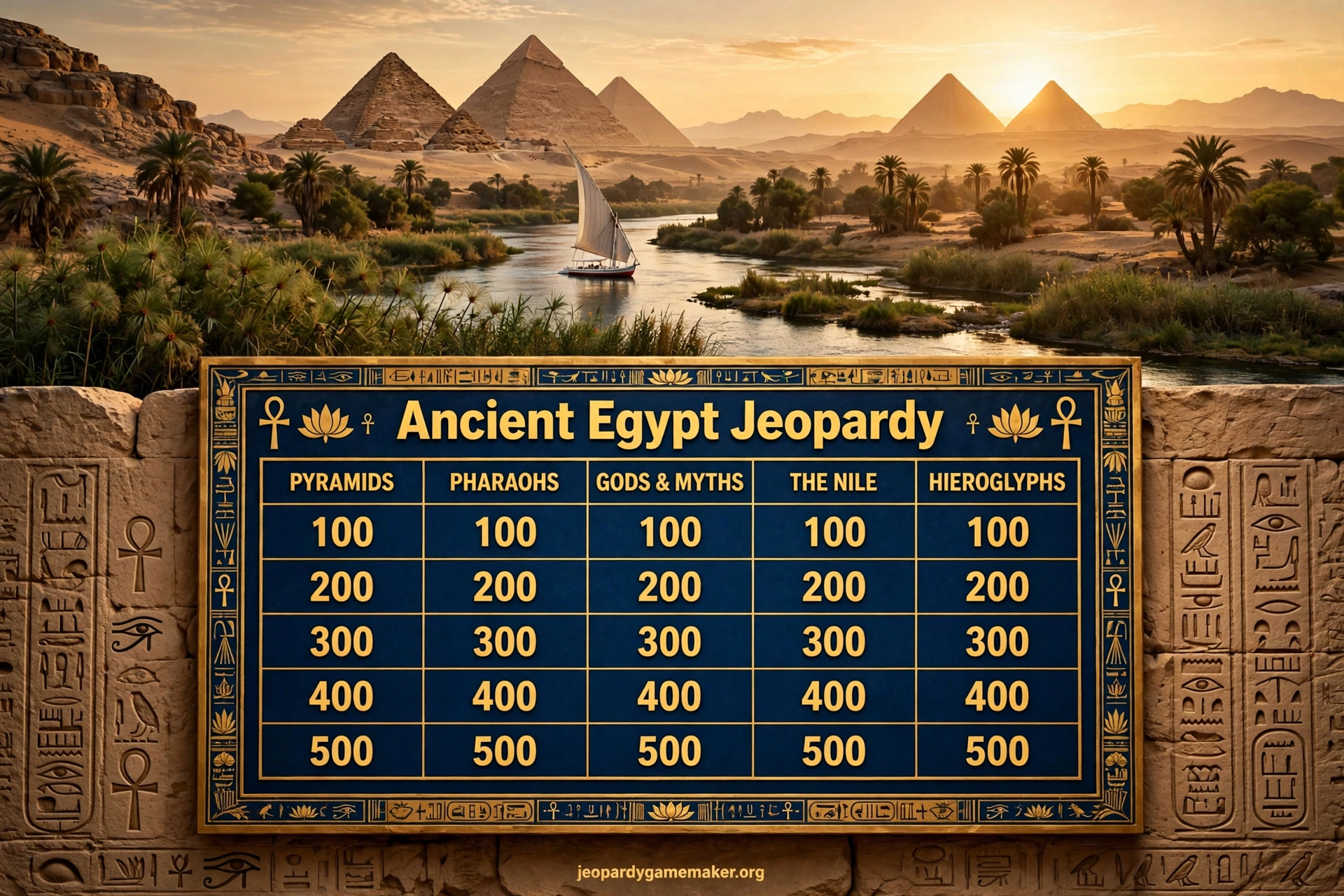
If you want a history game students remember, ancient egypt jeopardy is a strong place to start. Pharaohs, pyramids, the Nile, and hieroglyphs give ready topics and clear answers.
You can play it in class, at home, or in a revision session, and you do not need to print anything.
Most history quizzes feel like a test with a new name. This one feels like a game because teams choose, risk, and cheer. Students who stay quiet in a normal lesson often speak up when their team needs a point.
This guide gives you a complete board you can use today. You will get five categories, twenty five clues with answers, hosting steps, and tips for different ages. You can copy the board as it is, or change any clue to match your lesson.
Why Ancient Egypt Works as a Game Topic
Ancient Egypt works because students already know something about it before the game starts. Most of them have seen a pyramid picture, heard of a mummy, or know the name Cleopatra. That starting knowledge makes the first clues feel fair, not scary.
The topic also has clear facts with short answers. A pharaoh name, a river name, or a god name fits the question and answer format well. You do not need long explanations for most clues, so the game keeps moving at a good pace.
Visual topics help too. Pyramids, temples, hieroglyphs, and the Nile are easy to picture. When a clue mentions a picture or a place, students can guess even if they do not know the exact word. That keeps weaker teams in the game longer.
The topic suits many ages. Younger students enjoy gods, animals, and daily life. Older students can handle dates, building methods, and writing systems. You can raise the difficulty by changing a few $400 and $500 clues, without rebuilding the whole board.
How the Game Works
The game uses a board with five categories and five point values in each one. Teams pick a category and a value, hear the clue, and try to give the correct answer.
A correct answer wins the points, and a wrong answer can pass to another team if you set that rule.
You can play with two to four teams, which suits most classrooms. Small groups work well too, with each student playing alone or in pairs. For a large class, split students into teams and let a captain answer for the group.
The board in this article is ready to use, and you can edit every part of it. Change a category name, rewrite a clue, or swap an answer to fit your textbook.
Start from a ready template if you want a base board first, then shape it into an Egypt board.
Scoring stays simple, which helps the host. Keep a running total on the board or on paper, and read the score after each round of five clues. A short score check keeps teams interested and stops one team from running away unnoticed.
A Final Jeopardy round is optional. You can add one hard clue at the end, let teams wager points, and finish with a close result. If time is short, skip it and simply declare the team with the most points the winner.
A Sample Board You Can Copy
The board below uses five clear categories: Pharaohs, Pyramids, Nile River, Gods and Goddesses, and Daily Life.
Each clue is short, and each answer is one fact a student can learn and repeat. Use it as it is, or edit the harder rows for older students.
| Points | Pharaohs | Pyramids | Nile River | Gods and Goddesses | Daily Life |
|---|---|---|---|---|---|
| $100 | Clue: This boy king ruled Egypt as a child and his tomb was found in 1922. Answer: Tutankhamun. | Clue: These large stone structures were built as tombs for pharaohs. Answer: Pyramids. | Clue: This river gave Egypt water, food, and a way to travel. Answer: The Nile. | Clue: This sun god was one of the most important gods in Egypt. Answer: Ra. | Clue: Egyptians wrote using pictures and symbols called this. Answer: Hieroglyphs. |
| $200 | Clue: This female pharaoh ruled Egypt and built a famous temple at Deir el-Bahari. Answer: Hatshepsut. | Clue: The largest pyramid at Giza was built for this pharaoh. Answer: Khufu. | Clue: The Nile floods each year and leaves rich soil for this activity. Answer: Farming. | Clue: This goddess was linked to magic, motherhood, and protection. Answer: Isis. | Clue: Egyptians made paper from this tall river plant. Answer: Papyrus. |
| $300 | Clue: This pharaoh built the temple at Abu Simbel with four giant statues. Answer: Ramesses II. | Clue: This structure near the pyramids has the body of a lion and the head of a king. Answer: The Great Sphinx. | Clue: The Nile flows from south to north and ends in this sea. Answer: The Mediterranean Sea. | Clue: This god of the dead was shown with the head of a jackal. Answer: Anubis. | Clue: Egyptians preserved dead bodies for the afterlife by making them into this. Answer: Mummies. |
| $400 | Clue: This last active ruler of ancient Egypt is famous for her skill in politics and language. Answer: Cleopatra VII. | Clue: Workers moved huge stone blocks for pyramids using ramps, sleds, and this kind of teamwork. Answer: Organised labour. | Clue: Egyptians built canals and basins to control flood water for this purpose. Answer: Irrigation. | Clue: This sky god was often shown as a falcon and linked to kingship. Answer: Horus. | Clue: This trained writer kept records, wrote letters, and worked for temples or the state. Answer: A scribe. |
| $500 | Clue: This pharaoh changed Egypt’s religion to focus on one god, Aten, before later rulers reversed it. Answer: Akhenaten. | Clue: The inside of a pyramid often held burial chambers, passages, and goods for this belief about life after death. Answer: The afterlife. | Clue: The Nile delta is the triangle-shaped land where the river splits before reaching the sea. Answer: The delta. | Clue: This god of the underworld judged the dead and was linked to rebirth and farming. Answer: Osiris. | Clue: Egyptians used this yearly calendar of about 365 days to plan farming and festivals. Answer: A solar calendar. |
If a clue feels too hard for your class, change only that cell. Keep the category and point value the same, and the board will still feel balanced.
If a clue feels too easy, add a second fact to it, such as a date or a place name.
How to Host It in Class
A simple 45 minute plan works well for most lessons. Start with a quick recap, play the board in rounds, and end with a short review. Students learn most when the game is paced well and every team gets turns.
| Time | Activity | What the host does |
|---|---|---|
| 0 to 5 minutes | Quick recap | Ask three easy Egypt questions and explain the rules. |
| 5 to 10 minutes | Easy round | Play the $100 and $200 rows so every team scores early. |
| 10 to 30 minutes | Main rounds | Play the $300 to $500 rows, with a score check halfway. |
| 30 to 40 minutes | Final round | Play any left clues, then add an optional final question. |
| 40 to 45 minutes | Review | Repeat the five hardest answers and link them to the lesson. |
Give each team a clear turn order and a time limit for answers. Ten to fifteen seconds is enough for most clues, and thirty seconds works for $500 clues. A timer on screen helps, but a simple count by the host also works.
Let teams talk before they answer. Short team talk builds thinking and stops one confident student from answering every clue alone. Ask the captain to give the final answer so the host knows who is speaking.
Keep the mood light in ancient egypt jeopardy when a team misses a clue. Read the correct answer, add one short fact, and move on. The game should feel like revision, not a test, even when the score is close.
For online classes, share your screen and read the clues aloud. Teams can answer by voice, by chat, or through a captain. The board itself stays on your screen, so students do not need any extra tool.
Tips for Different Ages
For younger students, use the $100 and $200 rows first and add picture hints. Show a pyramid photo, a Nile map, or a hieroglyph chart beside the board. Pictures help students who read slowly to join in with confidence.
For middle school students, play the full board and add short follow-up facts. After a gods clue, ask which god a farmer might pray to, and why. That one extra question turns a fact recall game into a thinking game.
For older students, raise the $400 and $500 rows with dates and causes. Ask why the Nile floods mattered, or why pyramid building needed strong organisation. Older students enjoy clues that reward understanding, not just memory.
For mixed ability classes, pair stronger and weaker students in the same team. Give each team a mix of roles, such as reader, captain, and score keeper. When roles rotate, every student gets a job and a reason to stay involved.
If your class also needs numbers practice, try a Math Jeopardy board on another day. The same hosting steps work, and students will already know the rules. That saves time and keeps the focus on the new subject.
Troubleshooting Common Problems
If the game feels too slow, shorten the answer time and skip team talk for easy clues. Play two clues per turn instead of one, and keep score checks brief. Speed matters more than perfect rules when energy drops.
If one team pulls far ahead, add a catch-up rule. Let the trailing team pick first in the next round, or offer a bonus clue worth double points. A close finish keeps the whole class engaged until the end.
If students argue about an answer, use a simple rule: the host decides, and the game moves on. You can check a disputed fact after the game, and award the point then if needed. Stopping the game for a long debate kills the pace.
If the board feels too hard, swap the hardest row before you play again. Replace $500 clues with facts from your last lesson, so the game rewards recent learning. A board that matches the lesson always plays better than a generic hard board.
If technology fails during ancient egypt jeopardy, keep a paper backup of the clues and answers. Read clues aloud, keep score, and let teams answer by raising hands. The game does not depend on fancy tools, only on clear clues and fair turns.
For more topic ideas, browse Jeopardy games by topic and pick a subject that fits your next lesson. A fresh topic each week keeps the format new, even when the rules stay the same.
Honest Limits
This game maker is browser based, so you play it in a web browser on a computer, tablet, or phone. There is no download and no signup needed to build or play a board, which keeps setup fast for teachers and students.
There is no native app, so you will not find a separate app to install for this maker.
There are also no phone buzzers, so teams answer by voice, by chat, or through a captain. That works well in class, but it is not the same as a buzzer system.
There is no downloadable slides template here, and no native Zoom integration. If you teach online, share your screen and use your meeting tool for voice and chat. The maker handles the board and scoring, while your meeting tool handles the call.
These limits are worth knowing before you plan a large event. For a normal classroom game, a revision session, or a family quiz night, the browser board is enough. For a big stage show with buzzers, you would need extra equipment outside this maker.
The how-to guide walks through building a board step by step, from topics to clues to play. Use it the first time you build your own board, then reuse the same steps for every new topic.
What to do next
Pick the ancient egypt jeopardy board above and play it once with your class. Note which clues were too easy, which were too hard, and which facts students remembered best. Those notes will make your next board stronger.
Then change five clues to match your current lesson. Swap in a fact from your textbook, a place from your map work, or a god from your last reading. A small edit is often better than a full rebuild.
Finally, save your edited board and share the link with your class for revision. Students can replay the same board at home, or use it to quiz each other in pairs. Replay is where much of the learning sticks.
Final Thoughts
Ancient Egypt gives teachers a rare mix: strong stories, clear facts, and topics students enjoy. A good board turns that mix into a game that teaches without feeling like extra homework. Start with the sample board, host it simply, and adjust it after one play.
The best ancient egypt jeopardy game is not the hardest one, but the one your students want to play again. Keep clues fair, keep turns moving, and keep the focus on learning together. That is how one game becomes a regular lesson part.
Next in history, try our Ancient Greece Jeopardy.
FAQs
1. Is ancient egypt jeopardy free to play?
Yes, you can build and play a board free in your browser. There is no download and no signup needed to use the maker for a normal classroom game.
2. How many clues are in the sample board?
The sample board has twenty five clues, with five categories and five point values in each category. You can use all of them, or play only the rows that suit your class time.
3. Can I edit the board for my lesson?
Yes, you can change category names, clues, and answers to match your textbook or your class level. Edit only the cells you need, and keep the rest of the board as it is.
4. What age group suits this game best?
It suits primary and secondary students, with small changes for age. Use picture hints for younger students, and harder $400 and $500 clues for older students.
5. Can I play this game online with students?
Yes, share your screen in your meeting tool and read the clues aloud. Teams can answer by voice or chat, and you can keep score on the board as you play.
6. Do I need to download anything to play?
No, the maker is browser based, so you do not need to download an app or a slides file. Open the board in a browser, play the game, and share the link if you want students to replay it.