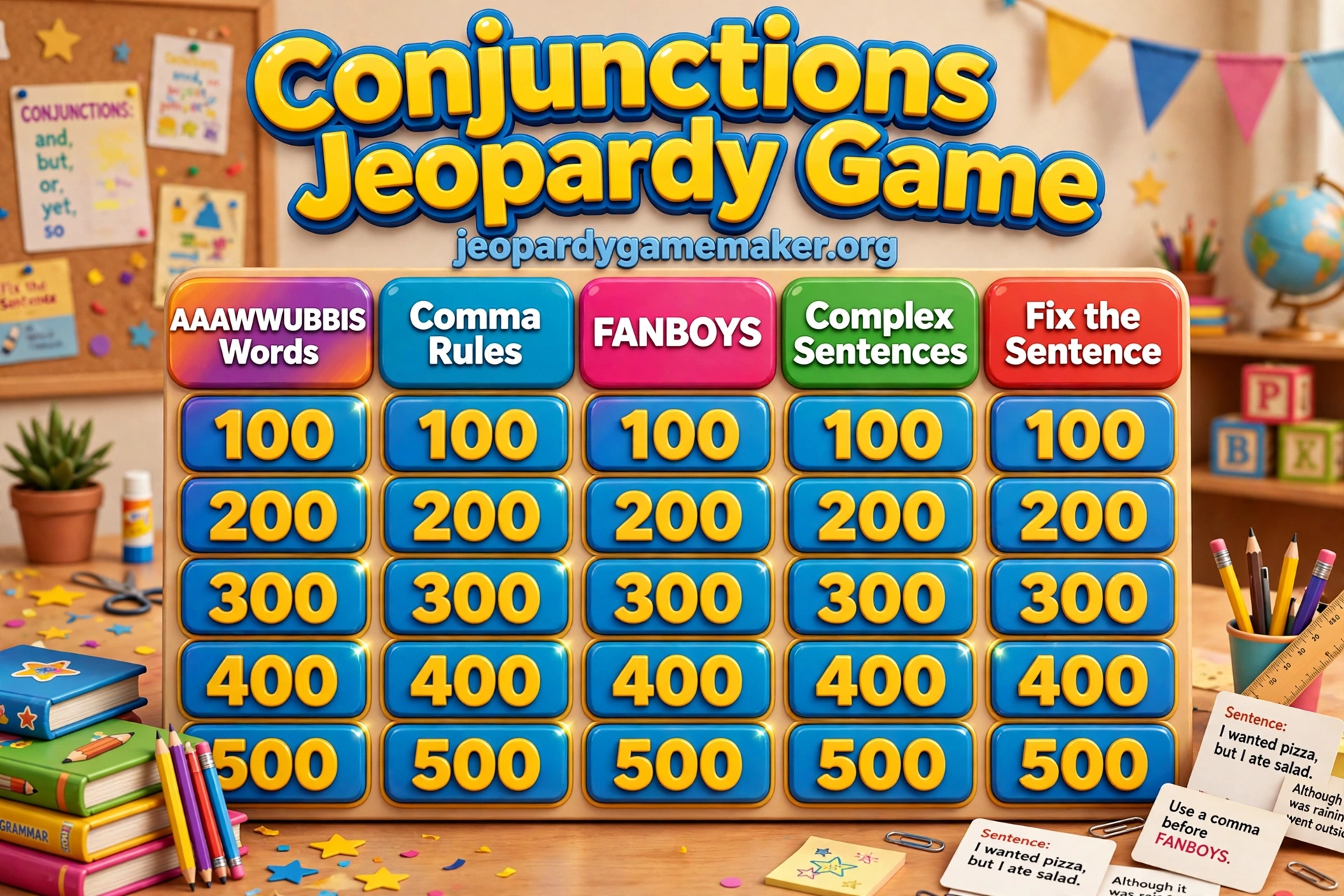
If you want a grammar lesson that students actually enjoy, conjunctions jeopardy game gives you a ready way to review AAAWWUBBIS words, comma rules, FANBOYS, complex sentences and sentence fixing in one lively lesson.
Grammar often feels dull when it is only rules in a book. In a game, those same conjunctions become clues to solve, and students start to notice how sentences fit together without being told to memorise a list.
A quiz board also shows you quickly what a class already knows. If most teams answer the AAAWWUBBIS clues with ease, you can move faster. If the comma rules cause debate, you know where to spend more teaching time.
This article gives you a full board to copy, clear hosting steps, and honest notes about the free maker.
Why Conjunctions Make a Great Classroom Game
Conjunctions work because they are built from small words students use every day. A sentence either feels complete or it leaves you waiting.
That clarity suits a quiz format. Teams can discuss a clue, agree on an answer, and learn at once whether they were right.
The five categories also cover different strengths. One student may spot AAAWWUBBIS words quickly. Another may be strong on comma rules. A third may be best at fixing sentences.
Grammar games also build writing confidence. When students fix a fragment to win points, the rule sticks far better than a warning about fragments.
How the Game Works
Split the class into two to four teams. Each team picks a category and a point value, from 100 to 500.
Read the clue aloud, give teams a short time to answer, then reveal the answer and add the points. The team with the highest score at the end wins.
Keep the pace brisk. If a team is stuck, move on quickly and let the next team pick. A slow game loses energy fast.
Use the low rows first with younger students. The 100 and 200 clues build confidence before the harder rows appear.
For older students, play the full board. The 400 and 500 clues test real knowledge, and they often decide a close game.
Let students answer in the form of a question if you like that classic style. It is not required, but many classes enjoy the extra challenge.
You can also add a sentence round. Read a sentence aloud without its comma, and let teams say where the comma belongs.
A Sample Classroom Board
The board below is ready to copy. It has five categories and five point values, making 25 clues in total. Use it as it is, or swap any clue for one from your own lesson.
| Points | AAAWWUBBIS Words | Comma Rules | FANBOYS | Complex Sentences | Fix the Sentence |
|---|---|---|---|---|---|
| $100 | Clue: After, although and as are the three words starting with this letter. Answer: What is A? | Clue: In “Although she was tired, she kept working”, the comma goes after this part. Answer: What is the dependent clause? | Clue: FANBOYS are this type of conjunction. Answer: What are coordinating conjunctions? | Clue: A complex sentence has one independent clause and at least one of these. Answer: What is a dependent clause? | Clue: Fix the fragment: “Because I was tired.” Answer: What is “Because I was tired, I went to bed”? |
| $200 | Clue: When and while are the two words starting with this letter. Answer: What is W? | Clue: When the AAAWWUBBIS clause comes second, you usually need this many commas. Answer: What is none (zero)? | Clue: FANBOYS build this type of sentence. Answer: What is a compound sentence? | Clue: A dependent clause has a subject and a verb but cannot do this alone. Answer: What is stand alone as a sentence? | Clue: Fix the sentence: “After we ate we left.” Answer: What is “After we ate, we left”? |
| $300 | Clue: Until and because are the words starting with these two letters. Answer: What are U and B? | Clue: In “After we ate we left”, the missing comma goes after this word. Answer: What is ate? | Clue: The F in FANBOYS stands for this word. Answer: What is for? | Clue: “Because it was raining” leaves you waiting, which shows it is this kind of clause. Answer: What is a dependent clause? | Clue: Fix the sentence: “Although it was late, but we kept playing.” Answer: What is “Although it was late, we kept playing”? |
| $400 | Clue: The full AAAWWUBBIS list has this many words. Answer: What is ten? | Clue: The rule: use a comma after the clause when the clause comes here. Answer: What is first? | Clue: The Y in FANBOYS stands for this word. Answer: What is yet? | Clue: In “Because it was raining, we stayed inside”, the main clause is this. Answer: What is “we stayed inside”? | Clue: Combine into one sentence: “It was raining. We stayed inside.” Answer: What is “Because it was raining, we stayed inside”? |
| $500 | Clue: The shorter AWUBIS list swaps until for this word. Answer: What is unless? | Clue: “She kept working although she was tired” needs a comma: yes or no. Answer: What is no? | Clue: The FANBOYS list ends with for, and, nor, but, or, yet and this word. Answer: What is so? | Clue: The “waiting” feeling of a dependent clause makes you ask this question. Answer: What is “Then what happened”? | Clue: Fill in the blank: “She waited ___ the bus arrived.” Answer: What is until? |
The board is balanced on purpose. AAAWWUBBIS words and FANBOYS are friendly starting points, while comma rules and sentence fixing reward students who practise writing closely.
For a full lesson, play all 25 clues. That usually takes 30 to 40 minutes, including team talk and answer reveals.
How to Build Your Own Conjunctions Board
Start from a ready-made template if you want a head start, then change the categories to fit your lesson. You can keep the conjunctions categories or add your own, such as prepositions, pronouns, verb tenses or punctuation.
Write short clues, not long paragraphs. Each clue should point to one clear answer, so teams can discuss it without getting lost.
Use sentences from your own lessons as clues. That links the game to what students were actually taught, and it makes revision feel useful.
Mix easy and hard clues in every category. If every clue is hard, weaker teams give up. If every clue is easy, strong teams get bored.
Keep answers short and clear. One word, one rule or one fixed sentence works best, and it avoids arguments about what counts as correct.
For more board ideas, browse the Math Jeopardy board to see how a different subject is laid out, then copy that structure for grammar.
Hosting Tips That Keep the Game Moving
Appoint one student as scorekeeper. That frees you to read clues, manage turns and keep the pace lively.
Set a time limit for each answer. Ten to fifteen seconds is enough for most clues, and it keeps the room alert.
Read each clue twice if the room is noisy. Students should hear the clue clearly before they start debating it.
Give every team a fair turn. If one team dominates, let the next team pick the category, even if they did not answer last.
Use the board as a review, not a test. Praise good reasoning, even when the final answer is wrong, and explain the correct answer briefly.
End with the highest rows if time runs short. The 500 clues make a strong finish, and students remember the game better that way.
You can find more topic ideas on the Jeopardy games by topic page, which groups boards by subject for classroom use.
What This Maker Cannot Do
Honesty matters, so here are the limits in plain words. The maker is browser-based, which means you open it in a web browser and play it there.
You do not need to download anything, and you do not need to sign up for an account to build and play a board. That keeps setup fast in a classroom.
There is no native app to install on a phone or tablet. If you want an app store game, this maker is not that product.
There are no phone buzzers built into the maker. Teams answer aloud, or the host can use a simple hand raise, a bell or a chat message for remote play.
There is no downloadable slide template offered here. You build and play the board in the browser, and you can share it by link instead.
These limits are also strengths in a school setting. No installs, no accounts and no extra tools mean fewer things can go wrong before a lesson.
If you need step by step setup help, the how-to guide walks through choosing topics, writing clues, entering them in the maker, previewing and playing with teams.
What to do next
Pick the sample board above and play it once with your class. One real game will show you which categories need easier clues and which need harder ones.
Then build your own conjunctions board with sentences from your next lesson. Keep the five categories, or swap one for prepositions, pronouns or punctuation.
Finally, try a second grammar topic next term. Conjunctions pair well with sentence writing, reading comprehension or essay practice, and students enjoy seeing how the subjects connect.
Final Thoughts
Conjunctions give teachers a rare mix: tiny words, clear rules and sentences students can fix with confidence. That mix makes them one of the best topics for a classroom quiz game.
A good board does not need fancy tools. It needs short clues, fair levels, a brisk pace and a host who keeps every team involved.
Use the sample board, adapt it to your class, and let students learn by playing. When grammar stops feeling like a list of rules, students start to write better sentences with real interest.
FAQs
1. Is a conjunctions jeopardy game good for younger students?
Yes, if you use the lower rows first. The 100 and 200 clues on AAAWWUBBIS letters and simple comma rules use everyday words, and you can skip the harder sentence-fixing clues until students are ready.
2. How do I explain AAAWWUBBIS in the game?
Use the board clues as examples. AAAWWUBBIS is a memory trick for ten subordinating conjunctions: after, although, as, when, while, until, because, before, if and since. Ask teams to name the word before they give the answer.
3. Which conjunctions clues should I start with?
Start with the AAAWWUBBIS letters and FANBOYS words, because students meet those lists first in most lessons. Add comma rules and sentence fixing only when the class is comfortable with the first two.
4. Can I change the conjunctions clues for my class?
Yes. Keep the five category structure, but swap any sentence for one your class is learning about, such as a sentence from a story you read together. Short clues and one clear answer per clue work best.
5. Do students need an account or a download to play?
No. The maker runs in a browser, with no download and no signup needed to build and play a board. Students simply watch the shared board and answer aloud as teams.
6. Can I play this game over a video call?
Yes. Share your screen so all players can see the board, read clues aloud, and let teams answer by voice or chat. Keep turns short and appoint a scorekeeper so the game stays smooth.
1 thought on “Conjunctions Jeopardy Game”