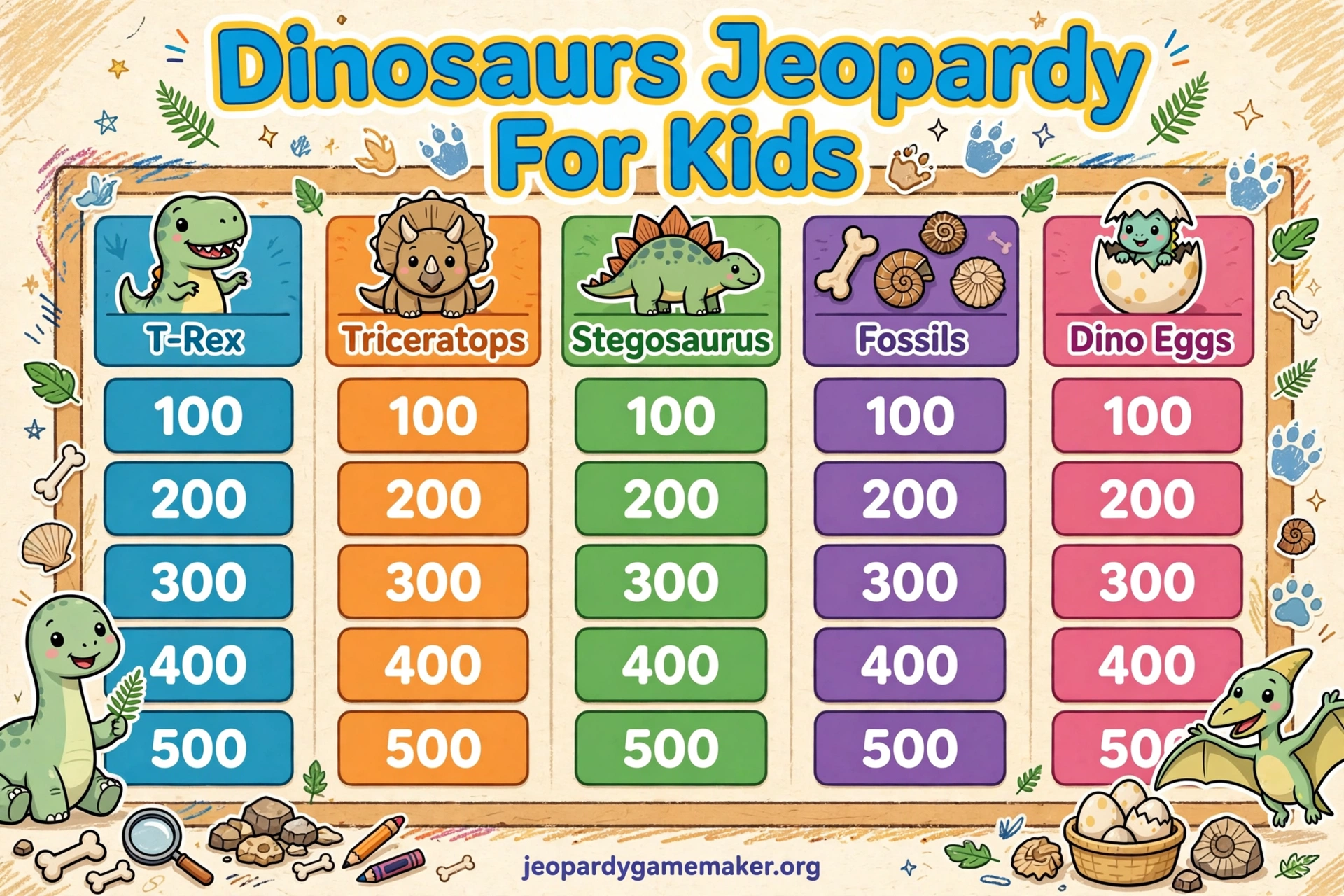
If you want a classroom game that gets every hand up, dinosaurs jeopardy for kids is a simple place to start. You open the board in your browser, read a clue, and let teams buzz in with an answer.
Dinosaurs are a perfect classroom theme. Most children already know a few dinosaur names, and the rest are fun to learn. A quiz board turns that excitement into reading, listening, and teamwork.
This guide gives you a ready board to play today. It also shows you how to host it, adapt it for different ages, and build your own version.
What Is Dinosaurs Jeopardy for Kids?
It is a quiz board game with five categories and five point levels. Each square hides one clue about dinosaurs. A team picks a square, hears the clue, and tries to give the right answer.
The board below uses real dinosaur facts. It covers names, fossils, diets, time periods, and sizes. Nothing here is a trick question, and every answer can be explained in one short sentence.
You can play it in a classroom, at home, or in a library group. The game works best with two to four teams, but a whole class can also play together.
Younger children can play with a teacher reading every clue aloud. Older children can read the clues themselves and keep their own score.
Why Dinosaurs Work So Well in Class
Dinosaurs mix science with story. Children learn new words like fossil, herbivore, and carnivore without feeling like they are doing a vocabulary drill. They also learn that science is about evidence, not just guessing.
A dinosaur board fits neatly into a science lesson. It can open a unit on prehistoric life, review a unit at the end, or fill a rainy day slot.
It also works for mixed-ability groups. Easy clues give every child a win early on. Harder clues stretch the children who already read dinosaur books at home.
Teachers like it because the rules are already familiar. Most children have seen a quiz show format, so you spend minutes playing, not explaining.
How to Play
Start by splitting the class into two to four teams. Give each team a name, such as Raptors, T-Rexes, or Fossil Hunters. Team names add fun and cost no time.
Pick a team to go first. That team chooses a category and a point value, for example, Fossils and Bones for 300. Read the clue aloud, slowly and clearly.
Give the team a short time to agree on an answer. Ten to fifteen seconds is enough for most clues. If the answer is right, add the points to that team’s score.
If the answer is wrong, you have two fair choices. You can let another team try for the same points, or you can move on to the next turn. Pick one rule and keep it for the whole game.
Keep going until the board is finished or your time runs out. The team with the most points wins, but a small prize for every team keeps the mood friendly.
A simple final round works well for older children. Ask one last question, let teams write their answer down, and add a bonus to the team that gets it right.
A Ready Dinosaur Board to Play
The board below has 25 clues. You can read it straight from this page, or copy the clues into your own board. Each clue has a short answer that you can explain in class.
| Category | $100 | $200 | $300 | $400 | $500 |
|---|---|---|---|---|---|
| Dinosaur Names | This dinosaur is famous for its huge jaws and tiny arms. Answer: What is Tyrannosaurus rex? | This long-necked plant eater is one of the tallest dinosaurs known. Answer: What is Brachiosaurus? | This three-horned dinosaur had a large bony frill behind its head. Answer: What is Triceratops? | This fast dinosaur had a sickle-shaped claw on each foot. Answer: What is Velociraptor? | This duck-billed dinosaur is named for the crest on its head. Answer: What is Parasaurolophus? |
| Fossils and Bones | A fossil is the preserved remains or traces of a living thing from long ago. Answer: What is a fossil? | Scientists who study fossils and ancient life are called this. Answer: What are paleontologists? | Dinosaur bones often turn to stone over millions of years in this process. Answer: What is fossilization? | Footprints, eggs, and nests are this kind of fossil evidence. Answer: What are trace fossils? | This hard material often replaces bone during fossilization. Answer: What is mineral? |
| What They Ate | A plant-eating dinosaur is called this. Answer: What is a herbivore? | A meat-eating dinosaur is called this. Answer: What is a carnivore? | Tyrannosaurus rex ate meat, so it was this kind of eater. Answer: What is a carnivore? | Brachiosaurus ate plants, so it was this kind of eater. Answer: What is a herbivore? | Some dinosaurs ate both plants and meat, and are called this. Answer: What is an omnivore? |
| When They Lived | Dinosaurs lived during this era, often called the Age of Reptiles. Answer: What is the Mesozoic Era? | This first period of the dinosaur age began about 252 million years ago. Answer: What is the Triassic Period? | This middle period is named for the Jurassic Coast rocks in England. Answer: What is the Jurassic Period? | Tyrannosaurus rex lived in this last period of the dinosaur age. Answer: What is the Cretaceous Period? | Dinosaurs died out about 66 million years ago, at the end of this period. Answer: What is the Cretaceous Period? |
| Big and Small | This is the largest land animal alive today, but it is much smaller than a Brachiosaurus. Answer: What is an African elephant? | A full-grown Tyrannosaurus rex was about this long, roughly 12 metres. Answer: What is 40 feet? | This tiny dinosaur was about the size of a chicken. Answer: What is Compsognathus? | Brachiosaurus could reach about this height, roughly 13 metres tall. Answer: What is 43 feet? | This giant plant eater may have weighed as much as 15 elephants. Answer: What is Argentinosaurus? |
Use the easy row first with younger children. The 100 point clues build confidence before you move to harder facts. With older children, let teams pick any square they like.
If a clue is too hard, turn it into a teaching moment. Read the answer, explain it in one sentence, and move on. The goal is learning, not catching children out.
Hosting Tips for Teachers
Read every clue aloud, even if children can read. It keeps the pace fair and helps children who read more slowly. It also stops one fast reader from answering every question alone.
Let teams talk before they answer. A short team huddle builds teamwork and gives quieter children a voice. It also stops the loudest child from answering for everyone.
Keep score where everyone can see it. A whiteboard score list works well. Update it after each answer so teams know where they stand.
Use a visible timer for older groups. A phone timer on the board works fine. For younger groups, skip the timer and keep the mood relaxed.
If the class is large, appoint a scorekeeper and a clue reader. Giving children jobs keeps them involved even when it is not their turn.
End with a quick review. Ask the class which fact surprised them most, and which part of dinosaurs jeopardy for kids they liked best. That one question turns a game back into a lesson.
A 45 Minute Classroom Plan
This plan fits one normal lesson. You can shorten it by cutting the warm-up or the final review.
| Time | Activity |
|---|---|
| 0 to 5 minutes | Split into teams, explain the rules, and pick a starting team. |
| 5 to 10 minutes | Warm up with the 100 point clues from two categories. |
| 10 to 35 minutes | Play the full board, with teams taking turns to pick squares. |
| 35 to 40 minutes | Play a final question round with written answers. |
| 40 to 45 minutes | Review the most surprising facts and announce the winning team. |
If you only have 20 minutes, play one row of categories instead of the full board. The game still works, and children still learn new facts.
Adapting the Board by Age
For ages 5 to 6, use only the 100 and 200 point clues. Read every clue aloud and accept close answers. Praise effort as much as correct answers.
For ages 7 to 8, play the full board but give extra thinking time. Let teams ask for one hint per game. A hint keeps a hard clue fair without giving the answer away.
For ages 9 to 10, add a written final round. Ask teams to write the answer and the reason in one sentence. This adds writing practice to the quiz.
For ages 11 and up, let children write their own clues for a second round. Writing clues is harder than answering them, and it shows real understanding.
For mixed age groups, pair younger children with older team captains. The older child reads, the younger child picks the square, and both share the win.
Make Your Own Dinosaur Board
Once you have played the ready board, you can build a version with your own clues. Start with the topics your class is studying, such as fossils or food chains. Five categories and five clues per category is a good target.
A template can help you start faster, because it gives you a ready board shape to edit. Change the categories, type your clues, and keep the point values simple.
If you want a maths version for another lesson, a Math Jeopardy board shows the same format with numbers instead of dinosaurs. The rules stay the same, so children already know how to play.
For more topic ideas, browse Jeopardy games by topic and pick a theme that fits your next unit. Science, history, and word games all use the same board style.
If you are new to building a board, the how-to guide walks through the steps in order. It covers choosing topics, writing clues, and playing with teams.
Keep your own clues short and clear. One fact per clue works best. Avoid clues with two answers, because they cause arguments about scoring.
Test your board once before class. Read each clue aloud and check that the answer is clear. A quick test saves time during the lesson.
Honest Limits to Know Before You Play
This game runs in your browser, and that brings a few clear limits. There is no download and no signup, which keeps setup simple. There is also no app to install on a phone or tablet.
There are no phone buzzers in this maker. Teams buzz in by speaking, raising a hand, or using a simple classroom signal. That works well in a room, but it is not a digital buzzer system.
There is no downloadable Google Slides template here. If you need a slide deck, you can still read clues from this page or copy them into your own slides by hand.
There is no native Zoom integration either. For a video call game, share your screen and let teams answer by voice or chat. The board itself still works fine that way.
These limits do not stop a good classroom game. They just mean you should plan for a speaker, a scorekeeper, and a clear buzz-in signal before you start.
What to Do Next
Play the ready board first, even if you plan to build your own later. One real game of dinosaurs jeopardy for kids shows you which clues are too easy, which are too hard, and how long a round takes.
Then change five clues to fit your class. Swap in a local museum fact, a book your class read, or a topic from your science unit. Small changes make the board feel personal.
Finally, save your board link so you can reuse it next term. A saved board can be replayed, edited, and shared with another teacher in minutes.
Final Thoughts
Dinosaurs make quiz games easy to love. Children already care about the topic, the facts are vivid, and the board format keeps everyone involved.
Start with the ready board in this guide. Host it with clear rules, fair turns, and a friendly score. Then build your own version when you are ready.
A good classroom game does not need fancy tools. It needs clear clues, fair teams, and a teacher who keeps the energy up.
FAQs
1. What age is dinosaurs jeopardy for kids best for?
It works best for ages 5 to 11, with small changes by age. Younger children play the easy clues with a teacher reading aloud. Older children play the full board and can write their own clues.
2. Do I need to download anything to play?
No, you do not need to download anything. The game runs in your browser, and you can read the board in this guide or copy it into your own board.
3. Do children need an account to play?
No, children do not need an account. Teams play together in the classroom, and no signup is needed to read or use the board here.
4. Can I use this board for a science lesson?
Yes, it fits a science lesson on prehistoric life, fossils, or food chains. Use it to open a unit, review at the end, or fill a short lesson slot.
5. How many teams should I use?
Two to four teams work best. Fewer teams mean longer turns, and more teams mean shorter turns. For a large class, add team jobs like scorekeeper and clue reader.
6. Can I change the clues for my class?
Yes, you can change any clue to fit your class. Keep clues short, use one fact per clue, and test the board once before the lesson.
1 thought on “Dinosaurs Jeopardy for Kids: A Free Classroom Dinosaur Board”