Quick Answer
A multiplication jeopardy game grade 3 turns times-table practice into a team board game that grade 3 students can play in a browser.
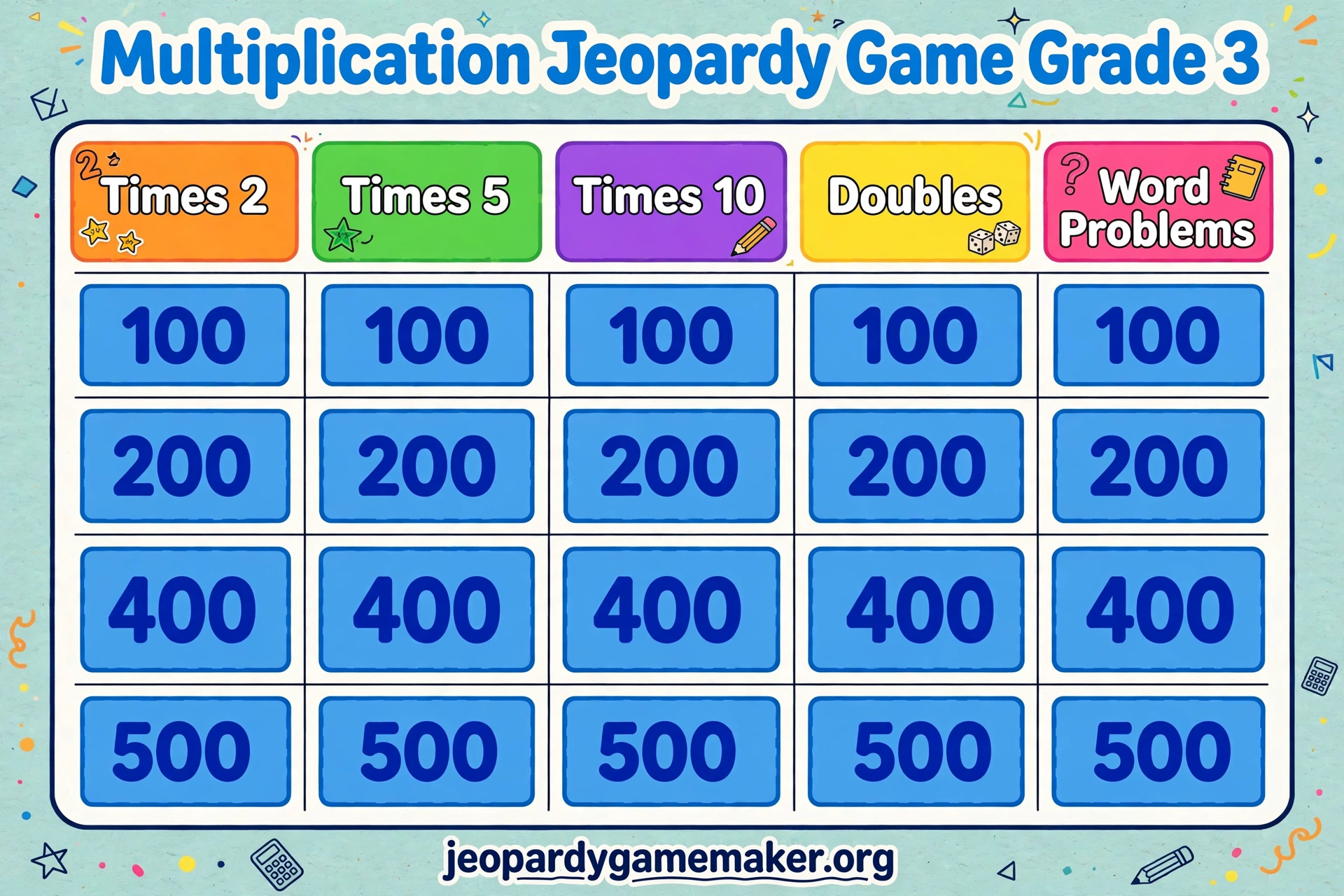
You build five categories, add five clues to each category, and let teams pick a point value for each clue.
A team answers the multiplication fact, the host reveals the answer, and the score moves on the board.
Why Times Tables Feel Hard in Grade 3
Grade 3 is often the first year when multiplication stops being a new idea and starts being a daily skill.
Students know addition well, but multiplication asks them to recall a fact fast, not count it out each time.
Counting on fingers works for small facts, but it slows down larger facts and makes word problems feel long.
A game changes the goal from finishing a page to answering a fact before another team does.
How This Board Works
The board has five categories across the top and five point values down the side.
Each category is one times-table family, such as the 2s, the 3s, the 4s, or the 5s.
The lowest point value holds the easiest fact in that family, and the highest value holds the hardest fact.
A team picks a category and a point value, reads the clue, and gives the product as the answer.
If the answer is right, the team earns the points for that clue.
A Sample Board You Can Copy
Use this board for a first game, then swap the facts for your own class facts in the next game.
It covers the 2s, 3s, 4s, and 5s, plus a mixed category for facts that combine those families.
Keep the facts short, so students can read the clue and answer without a long pause.
| Times 2 | Times 3 | Times 4 | Times 5 | Mixed Challenge |
|---|---|---|---|---|
| $100 | $100 | $100 | $100 | $100 |
| $200 | $200 | $200 | $200 | $200 |
| $300 | $300 | $300 | $300 | $300 |
| $400 | $400 | $400 | $400 | $400 |
| $500 | $500 | $500 | $500 | $500 |
Try a Times 2 $100 clue such as: What is 2 times 4?
Try a Times 3 $200 clue such as: What is 3 times 6?
Try a Times 4 $300 clue such as: What is 4 times 7?
Try a Times 5 $400 clue such as: What is 5 times 8?
Try a Mixed $500 clue such as: What is 4 times 9?
That is why a multiplication jeopardy game grade 3 board works best when facts stay short and answers stay checkable.
Build Your Board in About 15 Minutes
Start with one times-table family that your students already know well.
Write five facts for that family, from the easiest fact to the hardest fact you want to test.
Add a mixed category last, using facts from all four families in the game.
Save the share link once the board is ready, so you can open the same board on the classroom display.
If you want a ready starting point, try a Math Jeopardy board before you write your own facts.
If you want a ready starting board, use a template and swap in your own facts.
Set Up for a Classroom Game
Open the board on the teacher computer or on the device connected to the classroom display.
Open the board in full screen, so students at the back can read the categories and point values.
Test one clue and one answer before students arrive, so you know the display and sound are working.
Split the class into two to four teams, and write the team names where everyone can see them.
Teach the 2s First, Then Build Up
The 2s are a good first category because most grade 3 students can double a number with confidence.
Use facts such as 2 times 1, 2 times 2, 2 times 3, and 2 times 4 in the early rows.
Put a harder fact, such as 2 times 9 or 2 times 12, in the $500 row only if your class is ready for it.
Make the 3s and 4s Less Scary
The 3s often feel harder than the 2s, because the jump from one fact to the next is larger.
Help students by linking a 3s fact to a fact they know, such as 3 times 4 is one more group of 4 than 2 times 4.
The 4s can use the same trick, because 4 times a number is double the 2s fact for that number.
For example, 4 times 6 is double 2 times 6, which is double 12, which makes 24.
Mix one easy fact, two medium facts, and two harder facts in each of those categories.
Use the 5s as a Confidence Category
The 5s are a good confidence category because the answers follow a clear pattern.
Answers for the 5s end in 0 or 5, and students can often spot that pattern fast.
Why the Mixed Category Matters
A mixed category tests whether students can switch between families without a warning.
Use mixed facts that reuse the same families, not new families that students have not learned yet.
For example, mix 3 times 5, 4 times 3, 2 times 8, and 5 times 6 in one category.
Scoring That Keeps Every Team in the Game
Start with two to four teams, because more teams mean fewer turns for each student.
Let the team that picks a clue answer first, and let another team try only if the first answer is wrong.
End the game after a set number of clues if time runs out, and name the leading team as the winner.
A Board Compared With a Worksheet
A worksheet tests recall one student at a time, and the teacher checks the work after the lesson.
A board tests recall in public, with a team to help and a score that changes at once.
A board works best as a review step after students have learned the facts in class.
| Feature | Board Game | Worksheet |
|---|---|---|
| Who answers | Teams in turn | Each student alone |
| Feedback speed | At once, on the board | After marking |
| Team discussion | Built into play | Not built in |
| Best use | Review and recall | Quiet practice |
| Teacher check | Host checks each answer | Teacher marks later |
| Setup time | About 15 minutes | A few minutes |
| Fun factor | High for most classes | Lower for most classes |
A multiplication jeopardy game grade 3 works well on a Friday review, before a quiz, or at the end of a unit.
Classroom Checklist Before Play
Use this checklist once before the game, so tech problems do not eat into lesson time.
Check the display, the board, the teams, and the time limit before students sit down to play.
| Check | What to Do | Why It Matters |
|---|---|---|
| Display | Open the board in full screen | Every student can read the clues |
| Board | Test one clue and one answer | You catch a wrong answer early |
| Teams | Name two to four teams | Scoring stays clear and fair |
| Time | Set 10 to 20 seconds per answer | The game keeps moving |
| Link | Save the share link | You can reopen the board fast |
| Backup | Keep a printed clue list | You can keep playing if Wi-Fi drops |
If Wi-Fi drops, read clues from the printed list and track scores on paper until it returns.
Tips for Teachers and Parents at Home
Parents can use the same board at home with two teams, or with one child against a timer.
At home, a multiplication jeopardy game grade 3 board also works as a short review before a school quiz.
If a child misses a fact, show the step once, then give a similar fact right away for a second try.
For more category ideas, check the Jeopardy games by topic page for subjects beyond math.
Troubleshooting Common Problems
If the board will not load, refresh once and check that Wi-Fi is connected.
If the board looks blank, check that the page has fully loaded before you click a tile.
If the display shows only part of the board, set the display to mirror, not extend.
If scores reset after a refresh, note the scores on paper before you reload the page.
A multiplication jeopardy game grade 3 should feel challenging, not impossible, for the class playing it.
Honest Limits to Know
This game is practice, not a replacement for teaching multiplication.
Students still need direct teaching of what multiplication means, such as equal groups and arrays.
A game can build recall, but it cannot teach a new times-table family from zero on its own.
Answers on the board still need teacher checking, because tricky wording can make a fair fact feel unfair.
For example, a word clue that hides the numbers can test reading more than multiplication.
Keep clues direct in grade 3, such as asking for a product, not hiding the fact in a long story.
What to Do Next
A multiplication jeopardy game grade 3 is ready to test in one short lesson.
- Pick the four times-table families your class knows best.
- Write five facts for each family, plus five mixed facts.
- Test the board on the classroom display and save the share link.
Then play one round, note which facts were missed most, and fix those facts for the next game.
If you want step-by-step help with the maker, use the how-to guide before you build your first board.
Final Thoughts
Times tables become easier when students meet them often, in short bursts, with a clear goal.
A board game gives that burst a team, a score, and a reason to recall the next fact fast.
The best board is the one you can reuse next week with new facts for the same class.
FAQs
1. What is a multiplication Jeopardy game for grade 3?
It is a team board game where grade 3 students pick a category and a point value, then answer a multiplication fact to earn points.
2. Which times tables should a grade 3 board cover?
Start with the 2s, 3s, 4s, and 5s, plus a mixed category, and add more families only when the class is ready.
3. How long does a grade 3 multiplication game take?
A full board takes about 20 to 30 minutes, and a short game with fewer clues takes about 15 minutes.
4. Can I use this board at home with one child?
Yes, play with one child against a timer, or split the family into two teams and take turns picking clues.
5. Does this game replace teaching multiplication?
No, it is practice and review, and students still need direct teaching of equal groups, arrays, and multiplication facts.
6. How do I make my own board with my own facts?
Open the maker, write five categories and five clues for each category, check the answers twice, and save the share link.