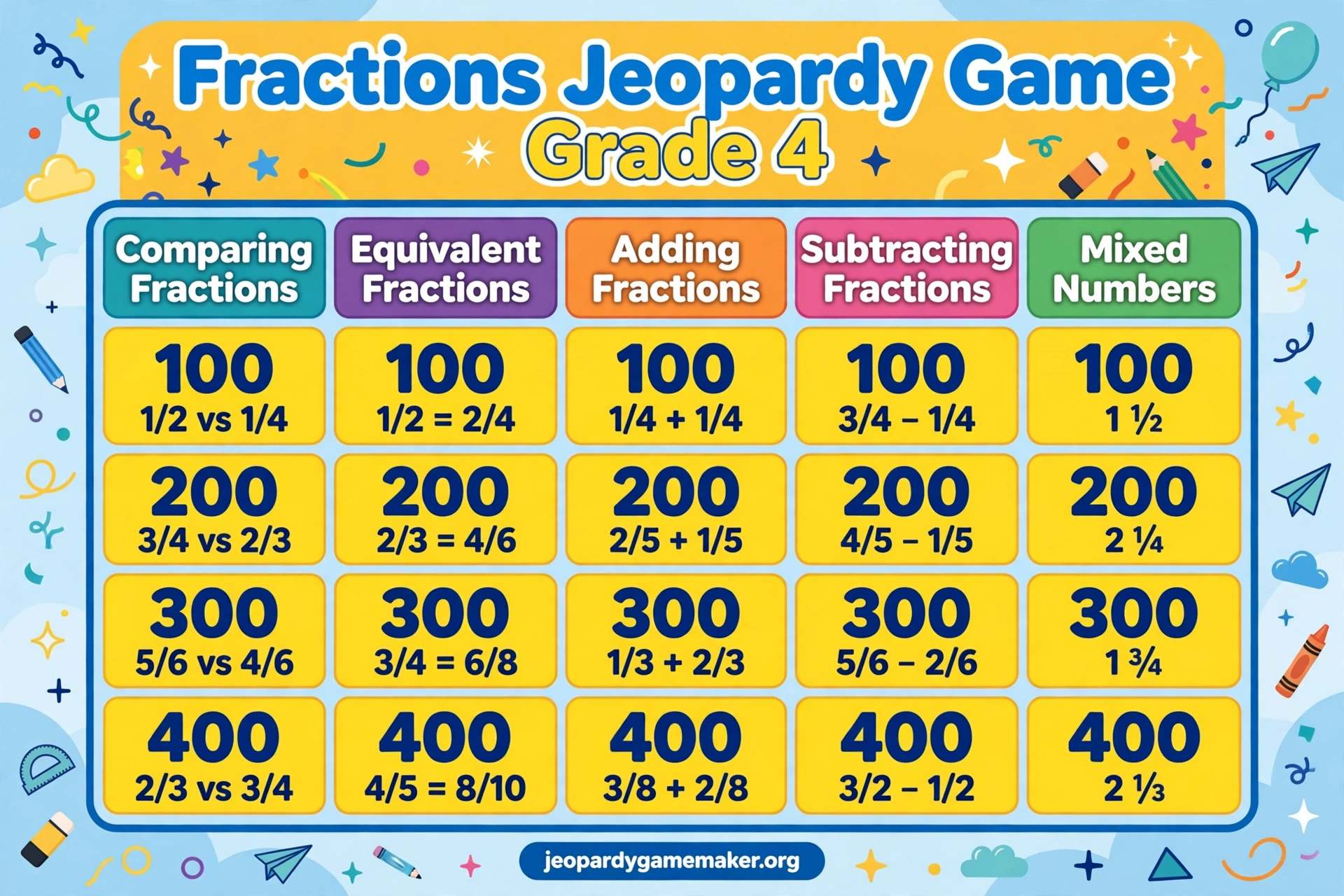
A fractions jeopardy game grade 4 turns a tricky topic into a team game. Students see a fraction, talk it through, and answer before time runs out. The board below is ready to use, and you can change every clue to fit your class.
Quick Answer
Use a 5 by 5 board for grade 4 fractions. That gives five categories and five point values in each category.
Start with simple naming and shading, then move to comparing and adding. Play with two to four teams. Give each team a turn to pick a clue. Reveal the answer only after the team has answered.
A full game takes about 30 minutes. That fits one class period with time left for a short review. Keep the pace brisk, and let teams talk before they answer.
What to Review Before You Play
Grade 4 fractions start with parts of a whole. Students should name a fraction from a shaded shape. They should also shade a shape to show a given fraction.
Next comes equivalent fractions. Show that 1/2, 2/4, and 4/8 name the same amount. Use bars, circles, and number lines for this step.
Comparing fractions comes after that. Students compare fractions with the same numerator. They also compare fractions with the same denominator.
Adding fractions with like denominators is next. Keep the denominator the same and add only the numerators. Word problems should use real things, like pizza, ribbon, and cups.
Keep this game inside grade 4 skills so every student can join in. A fractions jeopardy game grade 4 works best when no new skill appears mid-game.
How to Run a 25-Clue Game in Class
Open the board on a projector or a large screen. Put students into two to four teams. Let each team pick a captain to give the final answer.
Set a simple rule for answering. The team must answer in a short sentence. Other teams stay quiet until the answer is checked.
Give about 20 seconds for a $100 clue. Give about 30 seconds for a $300 clue. Give about 45 seconds for a $500 clue.
Award the points for a correct answer. Give no points for a wrong answer, or take points off if your class likes that rule. Tell students the rule before the first clue, not in the middle of the game.
Play all 25 clues if time allows. If time is short, play three categories only. When you run a fractions jeopardy game grade 4, ask after the last clue which category was hardest, and use that answer to plan the next lesson.
Difficulty Progression From $100 to $500
The point values are a teaching tool, not just a score. Low values build confidence. High values ask students to explain their thinking.
A $100 clue should be direct. Name the fraction, shade the shape, or pick the larger part. Every student should be able to try it.
A $200 clue should need one small step. Find an equivalent fraction, or compare two simple fractions. Students should show the step on paper if they need to.
A $300 clue should need a reason. Explain why two fractions are equal. Explain why one fraction is larger than another.
A $400 clue should mix two skills. Compare fractions, then use the answer in a short problem. This is where talk in the team helps most.
A $500 clue should be a word problem. In a fractions jeopardy game grade 4, keep the numbers small so the thinking stays on fractions.
Sample Board You Can Use Today
Use this board as a starting point for a fractions jeopardy game grade 4. Change any clue to match your textbook, and keep the same point order so the game stays fair.
| Points | Fraction Basics | Equivalent Fractions | Comparing Fractions | Adding Fractions | Fraction Word Problems |
|---|---|---|---|---|---|
| $100 | Name 3/4 from a shaded shape | Find a fraction equal to 1/2 | Which is larger, 1/3 or 1/6? | Add 2/8 + 3/8 | Sara ate 2/6 of a pizza. How much is left? |
| $200 | Shade 2/5 of a bar | Find a fraction equal to 3/4 | Which is smaller, 5/8 or 3/8? | Add 1/4 + 2/4 | A ribbon is 5/10 long. Cut off 2/10. How much is left? |
| $300 | What does the 4 mean in 3/4? | Is 2/6 equal to 1/3? Explain why | Order 1/2, 1/4, and 3/4 | Add 3/10 + 4/10 + 2/10 | Tom drank 3/8 of a jug. Mia drank 2/8. How much did they drink? |
| $400 | Write 1 whole as a fraction | Find two fractions equal to 6/8 | Compare 4/6 and 2/3 | Add 5/12 + 4/12 | A garden is 7/10 full. 3/10 is carrots. What part is not carrots? |
| $500 | Draw a model for 7/8 | Explain why 4/10 equals 2/5 | Which is closest to 1: 5/6 or 2/6? | Solve 3/9 + 5/9 and simplify | Ben read 4/12 of a book on Monday and 5/12 on Tuesday. How much did he read? |
Answers stay with the host; reveal each one after the team answers.
Why a Board Beats a Worksheet Here
A worksheet tests one student at a time. A board lets the whole class hear the thinking. Students learn from wrong answers too, when the teacher explains them fast.
| Feature | Fractions Board Game | Worksheet Only | Slide Deck Only |
|---|---|---|---|
| Team talk | Yes, every clue | No, mostly silent | Sometimes, if planned |
| Instant checking | Yes, reveal the answer | No, checked later | Yes, on the next slide |
| Score and pace | Built into the board | Added by the teacher | Added by the teacher |
| Change clues fast | Yes, edit the board | Rewrite the sheet | Edit many slides |
| Fun and focus | High, with a clear goal | Low for many students | Medium, depends on design |
A board also helps shy students, who can talk in a small team first before the captain answers. Use a worksheet after the game, not instead of it, and turn the five hardest clues into a short exit ticket.
Grade 4 Skills Checklist for This Game
Use this checklist when you write your own clues. Tick a skill only when the class has seen it before. Do not add a new skill in the middle of a game.
| Skill | Covered in This Board | Try It With |
|---|---|---|
| Name a fraction from a model | Yes | Shaded bars and circles |
| Shade a model for a fraction | Yes | Paper bars and grids |
| Find equivalent fractions | Yes | Fraction bars and number lines |
| Compare fractions | Yes | Same numerator or denominator |
| Add fractions, like denominators | Yes | Small numbers, clear models |
| Solve fraction word problems | Yes | Food, ribbon, and garden contexts |
| Simplify an answer | Only in one $500 clue | Keep it short and optional |
If a skill is not ticked, save it for a later game.
Team Play That Keeps It Fair
Mix strong and new learners in each team, and rotate the captain so one student does not answer every time. Let the team talk briefly, then ask for one clear answer, and ask for an explanation if it is close.
Keep scores on the board, so students see the score change. End with praise for good thinking, not only for points, and name a team that explained well.
In a fractions jeopardy game grade 4, a bonus $100 clue can give a team that is far behind a fair chance to catch up.
Common Problems and Quick Fixes
If students guess without thinking, add a rule. The team must give a reason with a $300 clue or higher. A guess with no reason gets no points.
If one team dominates, let the team with the lowest score pick next. If time runs out, finish the current category, announce the winner, and save the rest for tomorrow.
If the projector is small, use large text and read each clue out loud. If students argue about an answer, draw the fraction bars and let the model settle it.
Make Your Own Version in Minutes
Start with the sample board above. Replace the clues with your own unit words. Keep the categories, or rename them for your class. Use the maker to build your board in your browser.
A fractions jeopardy game grade 4 can be saved by link, so you can reuse it next term and share it with a co-teacher.
Need a ready board first? Open a template and edit the clues to fit grade 4 fractions. That is faster than starting from a blank board. You can keep the layout and change only the words.
For more math boards, open the Math Jeopardy board. Use it for ideas, then build your own fractions version. Keep your clues short, so students can read them fast.
What to Do Next
- Pick your five categories from the sample board.
- Change any clues that do not fit your class.
- Play one practice round with two teams.
Then save your board by link. Play it in class, and note which clues were too easy or too hard. Fix those clues before the next game.
Want more game ideas? Browse Jeopardy games by topic for other subjects. Then read the how-to guide for setup, scoring, and hosting tips. Both help you plan a smooth game with less prep time.
Final Thoughts
Fractions feel hard when students only see numbers on a page. A game gives those numbers a shape, a team, and a reason to talk, and that talk is where the learning happens.
Start simple, keep the rules clear, and let students explain. A fractions jeopardy game grade 4 works when students talk through each clue, so use the sample board, change what you need, and play it soon. Your class will remember the game long after the worksheet is gone.
FAQs
1. What grade is this fractions game for?
This game is for grade 4 students. It covers naming, shading, equivalent fractions, comparing, adding with like denominators, and simple word problems. Adjust the clues down for grade 3 review, or up for grade 5 review.
2. How long does a 25-clue game take?
A full game takes about 30 minutes. That includes team talk, answers, and a short review at the end. Play 15 clues if you have only 20 minutes.
3. How many teams should play?
Play with two to four teams. Two teams work well for a small class. Four teams work well when you want more students talking at once.
4. Can I change the clues in the sample board?
Yes, change any clue to fit your class. Keep the point order the same, so $100 stays easy and $500 stays hard. Save your version by link so you can reuse it.
5. Do students need to simplify their answers?
Only in a few hard clues. Most grade 4 clues should accept an unsimplified answer, as long as it is correct. Keep simplifying short, and explain it with a model.
6. Can I play this game without a download?
Yes, this game plays in your browser. Open the board, project it, and play with teams. No app install is needed for the host or the class.