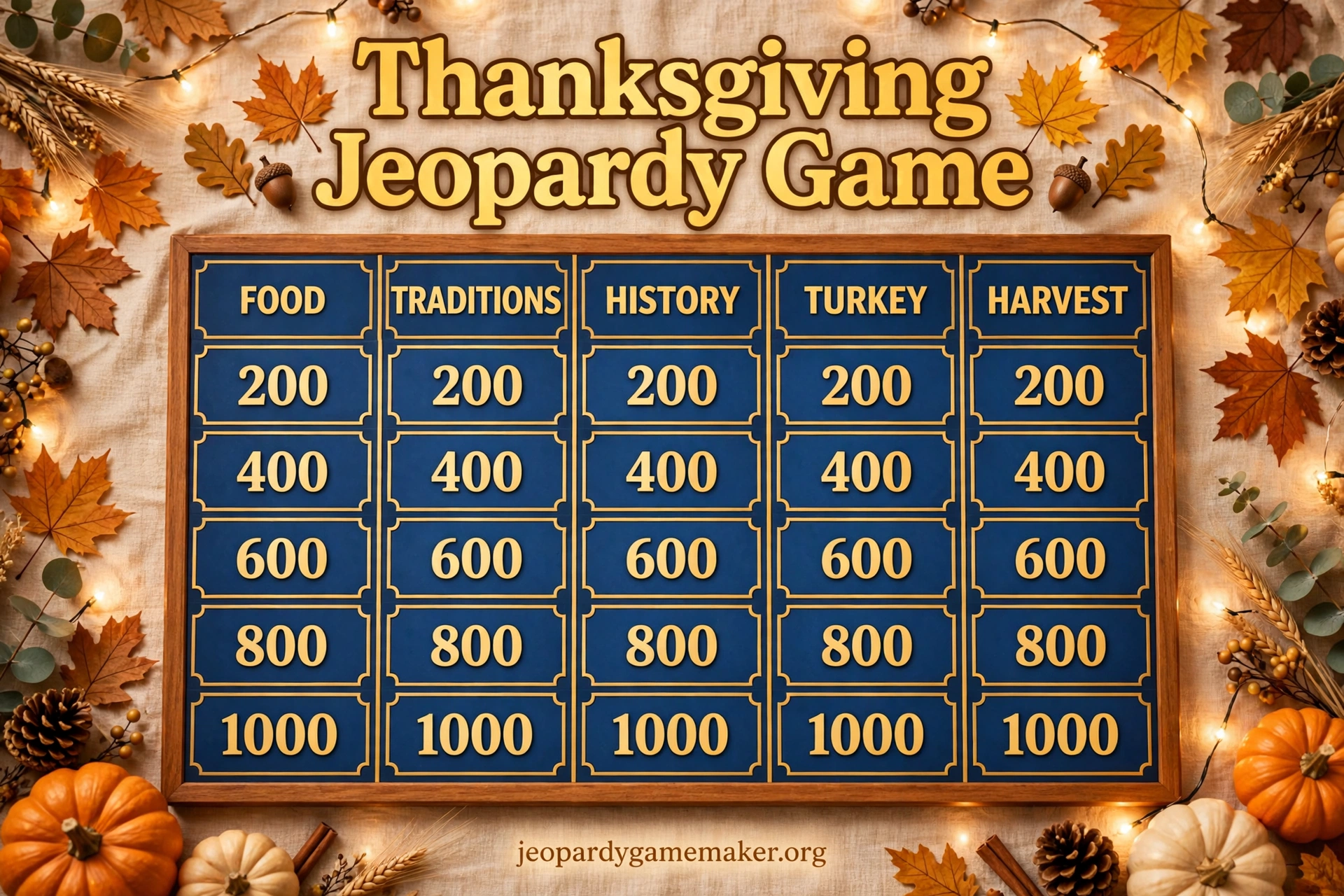
Use a thanksgiving jeopardy game to turn a quiet holiday afternoon into a team game in about 15 minutes.
You pick five categories, add 25 short clues, and play on one screen while teams answer out loud.
No download is needed, and no account is needed to start.
One person hosts, and everyone else plays from the same room or the same video call.
The game works for family, for class, and for friends.
Younger players can join a team with an older player, and adults can still enjoy the harder $500 clues.
Why this game works for Thanksgiving
Thanksgiving already brings people together around food and talk.
A board game gives that talk a simple shape, with teams, turns, and points.
It also solves the awkward gap after dinner.
Instead of everyone drifting to separate phones, one shared game keeps the room together for 30 to 40 minutes.
A thanksgiving jeopardy game fits that gap well because the topics are familiar.
Most guests know something about food, history, or family habits, even if they do not know every answer.
The format is forgiving too.
A team can guess, laugh at a wrong answer, and still win on the next round.
No one needs to be a trivia expert to enjoy it.
Sample board you can copy
Use the board below as a starting point for your thanksgiving jeopardy game.
Change any clue to fit your family, your class, or your own traditions.
The board uses five categories and five point levels.
Keep clues short, and keep answers clear, so the host can read them fast.
| Category | $100 | $200 | $300 | $400 | $500 |
|---|---|---|---|---|---|
| Thanksgiving History | First Thanksgiving year | Ship that brought the Pilgrims | Native tribe at the first feast | President who made it annual | Year of the first parade |
| Thanksgiving Food | Main dish at most tables | Orange side dish | Bread often served warm | Dessert with pumpkin | Sauce made from cranberries |
| Fall Fun | Activity in a corn maze | Sport watched in November | Leaf color in fall | Drink served warm and spiced | Festival held after harvest |
| Turkey Trivia | Sound a turkey makes | Baby turkey name | Turkey top speed | Weight of a large turkey | State that raises most turkeys |
| Family Traditions | What families share at dinner | Game played after dinner | Photo taken each year | Dish passed down in families | Way to thank the cook |
Build your board in 15 minutes
Start with the five categories above, then replace two or three clues with your own.
A personal clue makes the game feel special, even if the rest of the board stays simple.
Write clues as short facts, not as long sentences.
The host should be able to read each clue in one breath, and players should be able to answer in a few words.
Keep the $100 clues easy and the $500 clues harder.
That mix lets new players score early and keeps strong players interested until the end.
Check every answer before you play.
A wrong answer on the board can slow the game down and cause an argument at the table.
Use the maker to enter your categories and clues in order.
Preview the board once, then fix any spelling or missing answers before guests arrive.
Hosting timeline for game day
A short plan keeps the game calm, even with a large group.
Use the checklist below, and adjust the times to fit your meal.
Start early, not when guests are already hungry.
A board built the day before feels relaxed, and a board built at the last minute feels rushed.
| Time | Task |
|---|---|
| Day before | Pick categories, write clues, and check answers. |
| Morning | Load the board and test one tile on your screen. |
| Before dinner | Set teams, explain rules, and pick a host. |
| After dinner | Play for 30 to 40 minutes, then announce the winner. |
| After the game | Save the share link for next year. |
Set a time limit for each answer, such as 20 seconds.
A limit keeps the game moving, and it stops one long debate from taking over the night.
Give each team a clear name, such as Turkeys, Pumpkins, or Cranberries.
Names make scoring easy to follow, and they make the game more fun for kids.
Team play rules that keep it fair
Split players into two to four teams, based on group size.
Small groups can play as two teams, and large groups work better with three or four.
Let teams take turns picking a category and a point value.
The team that picks the clue answers first, and other teams can steal only if the host allows it.
Award the full point value for a correct answer, and award nothing for a wrong answer.
Simple scoring avoids arguments, and it keeps the game friendly for family play.
For classrooms, mix strong and new players on each team.
That balance helps quiet students join in, and it stops one team from winning every round.
If a team is far behind, add a final fun round.
One last $500 clue can change the result, and it gives every team a reason to stay in the game.
Play on a projector or on Zoom
A thanksgiving jeopardy game works well on a large screen, because everyone can read the board at once.
Use a TV, a projector, or a laptop connected to a display.
Put the host near the screen, with the board controls in hand.
The host reads the clue, reveals the answer, and updates the score, while players focus on answering.
For Zoom, share only the board window, not your full desktop.
Ask players to answer out loud or in chat, and let the host mark the score for each team.
Keep the room quiet while a clue is read, and keep answers short.
A clear host voice matters more than fancy effects, especially on a video call.
Test sound and screen size before guests arrive.
A quick test takes two minutes, and it prevents a long pause when the game should start.
Browser board or slide template
A browser board is faster to build than a slide deck, because you do not need to link dozens of slides by hand.
You enter clues once, and the board handles the layout and scoring.
A slide template can look good, but it takes longer to edit, and one broken link can stop the game.
A printable set is useful as a backup, but it cannot score teams for you.
Use the comparison below to pick the method that fits your time and your group.
| Option | Setup time | Cost | Best for |
|---|---|---|---|
| Browser board | About 15 minutes | Free | Family, class, and Zoom play |
| Slide template | 1 to 3 hours | Varies | Hosts who want full slide control |
| Printable cards | 30 to 60 minutes | Printing cost | Small groups with no screen |
If you want a fast start, pick the browser board.
If you want a printed backup, print the clues as well, but keep the browser board as the main game.
For more ideas, browse the template options on the site, and pick a starting board that matches your group.
A ready board saves time, and you can still change its clues.
Troubleshooting before guests arrive
If your thanksgiving jeopardy game board will not load, reload the page once and check your internet connection.
A weak connection can delay the board, even if the rest of your device seems fine.
If text looks too small on a TV, move closer to the screen or increase the browser zoom.
The board should be readable from the back of the room, not just from the front row.
If a team cannot hear the host on Zoom, ask players to mute when they are not answering.
Background noise is the most common problem on video calls, and muting fixes it fast.
If a clue feels too hard, let the host give a small hint.
A hint keeps the game fun, and it stops a hard clue from ending the round early.
Save your board link after you build it.
That link lets you return to the same board later, and it helps if you need to reload during the game.
For topic ideas beyond Thanksgiving, look at Jeopardy games by topic on the site.
Those pages can spark new categories for your next family game night.
What to do next
- Open the maker and load the sample board above.
- Change two or three clues to fit your family or class.
- Test one tile, set your teams, and play after dinner.
A thanksgiving jeopardy game works best when it stays simple.
Build it early, keep clues short, and let the teams do the talking.
Final Thoughts
Thanksgiving is about time together, not about perfect trivia.
A thanksgiving jeopardy game with a simple board, clear rules, and short clues is enough to make the evening memorable.
Start with the sample board, add a few personal touches, and host with a calm voice.
The best game is the one where everyone gets a turn, and no one feels left out.
For a step-by-step build guide, read the how-to guide on the site.
It walks through categories, clues, and hosting in five simple steps.
For a ready starting board on another subject, try the Math Jeopardy board on the site.
It shows how a full board looks, and you can adapt its layout for your own game. Next holiday coming up? Try our Christmas Jeopardy game.
p>
FAQs
1. How long does a Thanksgiving game take to play?
A full 25-clue board takes about 30 to 40 minutes with two to four teams.
A short version with 15 clues takes about 20 minutes, which fits well after dinner.
2. Can kids play this game with adults?
Yes, kids can join a mixed team with an older player.
Keep the $100 and $200 clues easy, and let kids pick the category for their team.
3. Do I need PowerPoint to play?
No, you do not need PowerPoint or any slide file.
The board runs in your browser, so you only need a screen and an internet connection.
4. How many teams should I use?
Use two teams for a small group, and three or four teams for a large group.
Four teams keep scoring simple, and they give more players a chance to answer.
5. Can I play this game on Zoom?
Yes, share the board window on Zoom and let players answer out loud or in chat.
The host controls the board and updates the score for each team.
6. Can I reuse this board next year?
Yes, save the share link for your board, and open it again next year.
You can also change a few clues each year to keep the game fresh, and a thanksgiving jeopardy game board built this way stays easy to update.
1 thought on “Thanksgiving Jeopardy Game – Play a Free Family Game in Minutes”